Power and energy
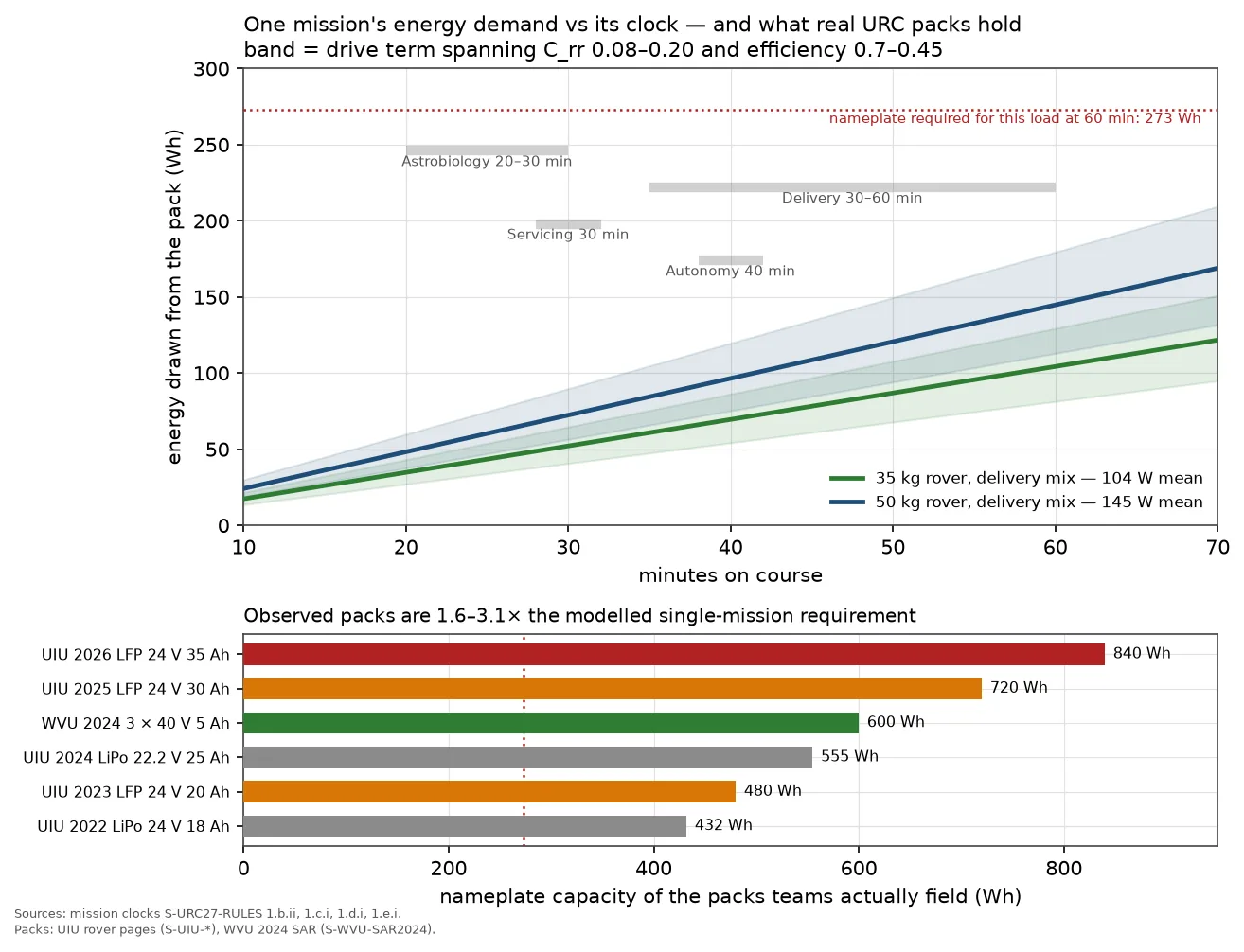
A 50 kg URC rover draws about 249 W on average and can pull 3.7 kW for a few seconds, a ratio of roughly 15 to 1. The average is what sizes the battery; the peak is what sizes the fuse, the contactor and the parallel count of the pack. Between those two numbers sits the energy budget, and it is dominated by the one mission that may run for a full hour: the 60-minute Delivery requires 145 Wh of mission energy and 273 Wh of nameplate capacity at 50 kg. The sample is a parameter model of eight mission cases plus the eight packs teams have published.
Key takeaways
- Average and peak are separate budgets. The average sizes the cells; the peak sizes the protection. A 4P pack of 21700 cells is rated 180 A continuous, which is the minimum parallel count for a credible 156 A simultaneous peak, and that pack lands at about 496 Wh.
- The 60-minute Delivery is the energy driver. Every other mission fits inside 106 Wh at 50 kg. Delivery is 37 % above the next largest and its clock is the longest in the rules, at up to 60 minutes.
- Derating, not the cells, sets the nameplate. 145 Wh of mission energy becomes 273 Wh of nameplate through a 25 % margin and a combined usable fraction of 0.662.
- Observed packs are 1.6 to 3.1 times the model. The six packs in the static figure hold 432 to 840 Wh, because current capacity, two missions on one charge and unmodelled hotel growth all push capacity up.
Average draw and peak draw
The subsystem power study produced a 50 kg, 35-minute load table at 249 W mean and 146 Wh, with a 3.7 kW everything-at-once peak. The mass-parameterised model reaches the same driving power from the other direction and splits it into mission stages, using the mission clocks published in the rules S-URC27-RULES §1.
| Load | 35 kg design | 50 kg design | Basis |
|---|---|---|---|
| Hotel load at the battery | 46 W | 63 W | Compute, radios, cameras, fans, status lights and conversion loss |
| Drive, while driving | 86 W | 123 W | 2.46 W/kg, rolling resistance 0.12, 3° mean grade, 0.8 m/s, efficiency 0.55 |
| Arm, while active | 20 W | 29 W | 3.0 W/kg of arm; arm is 19 % of rover mass |
| Science, while active | 25 W | 25 W | Pumps, lamp, detector and heater; mass-independent |
| Credible simultaneous peak | 156 A at 25.6 V, about 4.0 kW | Climb, one stalled arm joint and hotel load |
The hotel load is nearly mass-independent, rising 37 % for a 43 % increase in mass, while the drive load is proportional to mass. A light rover is hotel-dominated and a heavy rover is drive-dominated. The two peak estimates differ because they answer different questions: 3.7 kW is what happens if everything runs at once, and 4.0 kW is a credible simultaneous event. Either way the peak is 120 to 160 A at 24 to 26 V, against an average of 95 to 160 W.
Energy by mission
| Rover | Mission | Minutes | Mean power | Energy |
|---|---|---|---|---|
| 35 kg | Astrobiology | 30 | 93 W | 46 Wh |
| 35 kg | Delivery | 60 | 104 W | 104 Wh |
| 35 kg | Equipment Servicing | 30 | 69 W | 35 Wh |
| 35 kg | Autonomy | 40 | 114 W | 76 Wh |
| 50 kg | Astrobiology | 30 | 125 W | 62 Wh |
| 50 kg | Delivery | 60 | 145 W | 145 Wh |
| 50 kg | Equipment Servicing | 30 | 95 W | 47 Wh |
| 50 kg | Autonomy | 40 | 159 W | 106 Wh |
| 50 kg | Autonomy then Servicing, one pack | 70 | 153 Wh |
These are model outputs, not measurements. The mission mixes that produce them are drive, arm, science and idle fractions estimated from the task content of each mission S-URC27-RULES §1.
From mission energy to a pack
| Step | 50 kg, one 60-minute Delivery | Basis |
|---|---|---|
| Mission energy | 145 Wh | Model |
| Add 25 % mission margin | 181 Wh | Unmodelled hills, radio at maximum, extra arm moves |
| Divide by 0.80 depth of discharge | 227 Wh | 80 % discharge is about 400 cycles against 600 at 60 % |
| Divide by 0.92 for temperature and ageing | 246 Wh | 38 °C ambient plus end-of-life capacity loss |
| Divide by 0.90 path efficiency | 273 Wh | Sizing at the bus, not the cells |
| Combined usable fraction | 0.662 | 0.80 × 0.92 × 0.90 |
The same chain gives 289 Wh for the back-to-back Autonomy then Equipment Servicing pair in one pack. The recommended pack for a first 2027 team is 400–500 Wh at 8S, lithium-ion 21700, 2.4–2.9 kg including BMS and enclosure. That covers the 289 Wh case with 38 to 73 % headroom, allows a second mission on one charge and keeps the pack small enough that a 4P current rating is comfortable.
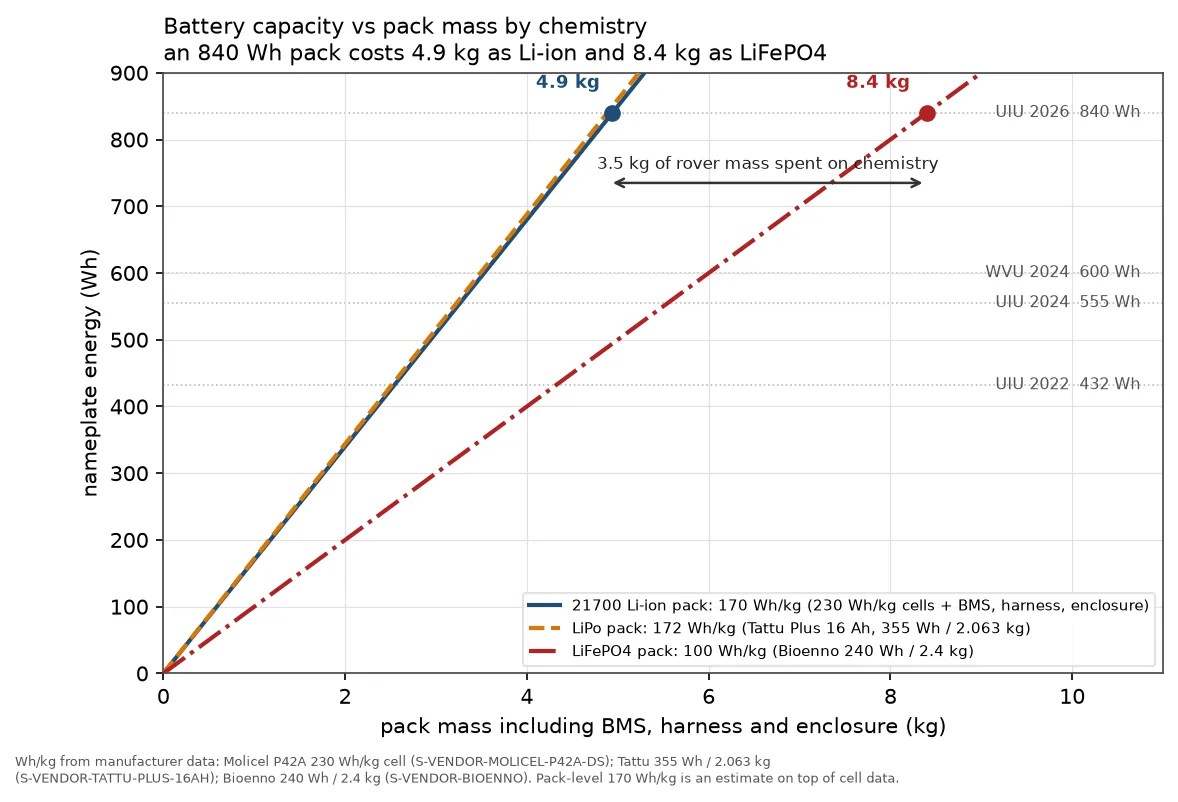
The interactive view plots the eight packs in the data table that publish a nameplate energy, from 320 to 840 Wh. The static figure above shows the six largest of them against the modelled requirement.
Observed capacity runs 1.6 to 3.1 times the single-mission model. Four explanations fit the record better than “teams oversize”: a 120 A peak needs at least three cells in parallel for current alone, a second mission may follow within ten minutes, unmodelled hotel growth (West Virginia’s 2026 rover runs eleven cameras, a 3D lidar, three radios and two computers), and a lithium iron phosphate pack holds about 70 % more mass for the same energy, at 100 Wh/kg against 170 Wh/kg for lithium-ion. UIU’s pack grew from 432 Wh to 840 Wh across five generations while the rover mass stayed flat at 47.5–49.8 kg S-UIU-ROVER-PAGE-AURION S-WVU-SAR2026.
The values on this page
| Statistic | Value | Definition | Period | Sample | Source | Chart and chapter |
|---|---|---|---|---|---|---|
| Average draw | 249 W | Mission-mix mean, 50 kg rover | 2027 model | 35-minute load table | S-URC27-RULES | Mass and power |
| Peak draw | 3.7 kW | Everything-at-once estimate | 2027 model | 35-minute load table | S-URC27-RULES | Power subsystem |
| Credible peak | 156 A, 4.0 kW | Climb, stalled arm joint and hotel | 2027 model | 50 kg rover | S-URC27-RULES | Chart above; Power subsystem |
| Delivery energy | 145 Wh | 50 kg, 60-minute delivery mix | 2027 model | One mission case | S-URC27-RULES | Mass and power |
| Nameplate, one Delivery | 273 Wh | After 25 % margin and 0.662 usable | 2027 | One mission case | S-URC27-RULES | Mass and power data |
| Nameplate, back-to-back | 289 Wh | Autonomy then Servicing on one pack | 2027 | One mission pair | S-URC27-RULES | Mass and power data |
| Recommended pack | 400–500 Wh | 2.4–2.9 kg including BMS and enclosure | 2027 | First build | S-URC27-RULES | Power subsystem |
| Observed packs | 320–840 Wh | Published nameplate energies | 2022–2026 | 8 packs | S-UIU-ROVER-PAGE-AURION S-WVU-SAR2024 | Chart above; Mass and power data |
Evidence note
Every watt and watt-hour on this page is a model output from a bottom-up load table, not a measurement on a rover. No team publishes a measured energy per mission, so the model cannot be calibrated against the field. Its sensitivity is wide: the 60-minute delivery case ranges from 221 Wh to 410 Wh of nameplate across plausible rolling resistance, efficiency, speed, grade and duration. Duration and speed dominate, which is to say the energy budget is a driving-distance budget in disguise.
Sources for this page
- S-URC27-RULESUniversity Rover Challenge 2027 – Requirements and GuidelinesOriginal Archived copy
- S-UIU-ROVER-PAGE-AURION5th-gen flagship. Headline specs on the homepage: 47.5 kg total mass (under 50 kg limit), 2.0 m/s max, 6-DOF carbon-fibre manipulator, dual RealS…Original
- S-WVU-SAR2026Team Mountaineers System Acceptance Review 2026 (rover "Deimos"): tri-modal 2.4 GHz + 5.8 GHz + 70 cm, gimbal camera on antenna mast, 750 m LOS / 164 m NLOS high-noise test, antenna + radio budget linesOriginal
- S-WVU-SAR2024Team Mountaineers System Acceptance Review 2024 (rover "Heimdall"): dual-band 2.4 GHz + 900 MHz, 90°/120° sector antennas, 250 m / 1 km tested, antenna and radio budget linesOriginal