UIU Mars Rover Team
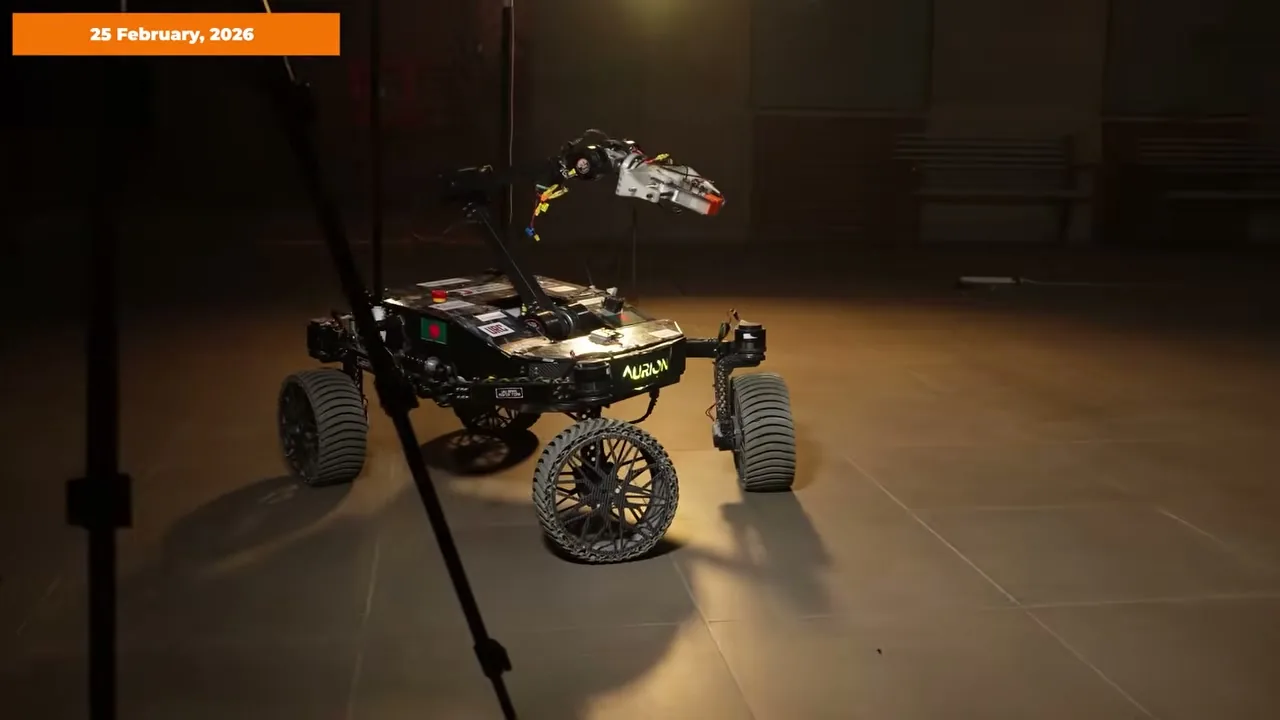
The UIU Mars Rover Team finished 3rd in 2026 with 400.44 points, having climbed from 13th in 2022, and it did so while its science rank fell from 1st to 18th. The podium came from autonomy tied for the field best, Equipment Servicing 2nd and Delivery 3rd. The programme is a five-generation run of new rovers built in six to ten months, each named, each with a five-minute review film as its only public design document.
What this team shows
- Rank is bought in autonomy, servicing and delivery. UIU’s science rank fell from 1st to 18th between 2025 and 2026 while the total rose 74.5 points S-URC25-SCORES S-URC26-SCORES.
- A wet-chemistry laboratory and an in-house Raman spectrometer are achievable for a student team, and one of them won the 2025 science award outright S-UIU-2025-SAR S-UIU-OLD-ACH.
- The 2026 rover dropped from six wheels to four to save mass and buy payload, and still placed on the podium S-UIU-2026-SAR.
- The review film is the design review. Five consecutive films with the same structure are the only reason this team’s engineering can be described at all S-UIU-2022-SAR S-UIU-2026-SAR.
Identity and results
| Year | Rover | Total | Rank | SAR | Science | Delivery | Equipment | Autonomy |
|---|---|---|---|---|---|---|---|---|
| 2022 | MAVEN | 236.67 | 13 | 90.92 | 70.00 | 18.75 | 23.00 | 34.00 |
| 2023 | TELOS | 273.59 | 9 | 93.06 | 68.73 | 45.00 | 50.00 | 16.80 |
| 2024 | YGGDRASIL | 304.25 | 5 | 89.25 | 79.00 | 30.00 | 72.00 | 34.00 |
| 2025 | AXIOS | 325.93 | 6 | 92.53 | 100.00 | 35.00 | 42.40 | 56.00 |
| 2026 | AURION | 400.44 | 3 | 94.81 | 85.00 | 62.00 | 72.63 | 86.00 |
The present programme begins in 2022, but the university’s first entry was 2017: 36th of 36, a review score of 76.4 and zero on all four missions S-URC17-SCORES. The present team dates its own origin to 2021, which is consistent with a restart under a new name and a new rover naming scheme rather than a first attempt. Since the restart it has qualified five years running, and among teams that competed in both 2022 and 2026 its gain of 163.8 points is the largest in the field S-URC22-SCORES S-URC26-SCORES.
The 2026 result is the first podium for the team and is described by its sponsor release as the first for an Asian team at the physical competition S-UIU-UNITED-2026. That claim is the release’s own and is not independently verified here; the score and rank are from the official sheet S-URC26-SCORES.
Rover generations
2022: MAVEN. Seventeen members working under pandemic restrictions with a modified agile method. A differential suspension with a topology-optimised chassis, a 24 V pack built from 18650 cells giving 120 minutes, a six-degree-of-freedom arm with an in-house cycloidal transmission and a semi-differential wrist rated to 7 kg, a 2.4 GHz radio to 3 km, and a science package with a secondary three-degree-of-freedom manipulator, four samples and three isolated beakers S-UIU-2022-SAR. Result: 13th.
2023: TELOS. Completely printed wheels with a flexible outer part over a rigid honeycomb core, because the previous wheels did not survive the terrain; a rocker-bogie with a rear differential bar and a spring tensioner; servo-driven steering that allowed sideways motion and pivoting on one point; a wrist moving from a belt drive to a semi-differential mechanism with a 1:3:9 reduction; a 1.4 GHz link; and the first appearance of an in-house Raman spectrometer S-UIU-2023-SAR. Result: 9th, with Delivery at 2nd in the field and autonomy at 16.8.
2024: YGGDRASIL. A carbon-fibre chassis with printed gyroid wheels, brushless steering, a six-degree-of-freedom arm lifting 10 kg, a centre-aligned parallel-sliding end effector, and object detection feeding inverse kinematics for semi-autonomous manipulation. The pivotal change was GPS to real-time kinematic positioning, with hybrid LiDAR and depth localisation, spiral search, and autonomous return to the previous waypoint on failure S-UIU-2024-SAR. Result: 5th, on the back of Equipment Servicing at 5th.
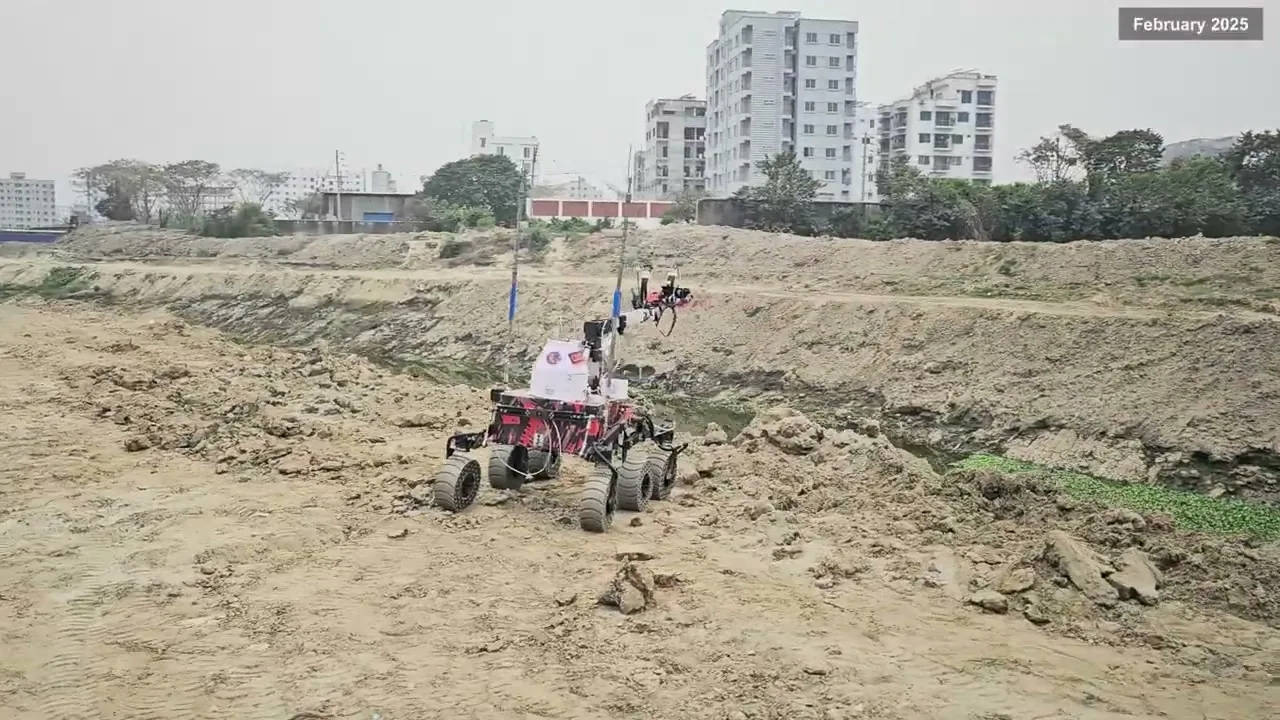
2025: AXIOS. The chassis was restructured and its centre of mass lowered, the power and control enclosure was repositioned, and the wheel mounts were widened with thrust bearings. The arm moved to carbon-fibre tubes and brushless wrist actuators with a pressure-sensitive end effector, and typing became autonomous from the base station using a tag and a time-of-flight rangefinder to register the arm to the keyboard. Autonomy moved to a navigation stack with behaviour trees and a filter fusing stereo, differential position and inertial data S-UIU-2025-SAR. Result: 6th, with the only perfect science score of the year.
2026: AURION. The mobility architecture changed from the six-wheel rocker-bogie used since 2022 to four wheels on a rocker per side, with a spring-loaded pivot and a rear differential bar, and the team’s stated reason is mass and payload capacity. Wheels grew 19 % in contact patch and diameter at 16 % less mass, a custom steering algorithm reduces slip to cut power, the arm was redesigned as five degrees of freedom with six joint units and a modular interface, and the battery became a 24 V 30 Ah lithium-ion pack with more than three hours of runtime S-UIU-2026-SAR. Result: 3rd.
Subsystems
Mobility. A flat carbon-fibre deck on an aluminium frame, with the suspension picking up at the four corners. The 2026 layout is one rocker per side rather than a bogie: there is no second rocker link, and a rear bar couples the two sides S-UIU-2026-SAR. Wheels are printed; the material history runs from a flexible outer over a honeycomb core, to a gyroid interior, to the 2026 carbon-core hybrid. Absolute wheel diameter and width are unpublished. Drive is by in-house brushless motors with a driver on each motor over CAN, so a single failed controller does not stop the rover S-UIU-2025-SAR. Steering is by the custom slip-reducing algorithm in 2026, and a 40° incline is claimed S-UIU-2026-SAR.
Arm and end-effectors. Five actuated joints plus a gripper, described by the team as six joint units, with a 7 kg payload S-UIU-2026-SAR. The payload fell from more than 10 kg in 2025, which is consistent with an arm built for precision and science-module swapping rather than for towing. Inverse kinematics is solved numerically in ROS, and the workspace was validated in a physics simulation before flight. The end effector is a two-finger, centre-aligned, parallel-sliding gripper that is pressure sensitive, on a standardised interface that can be exchanged for a science suite between tasks S-UIU-2024-SAR S-UIU-2026-SAR.
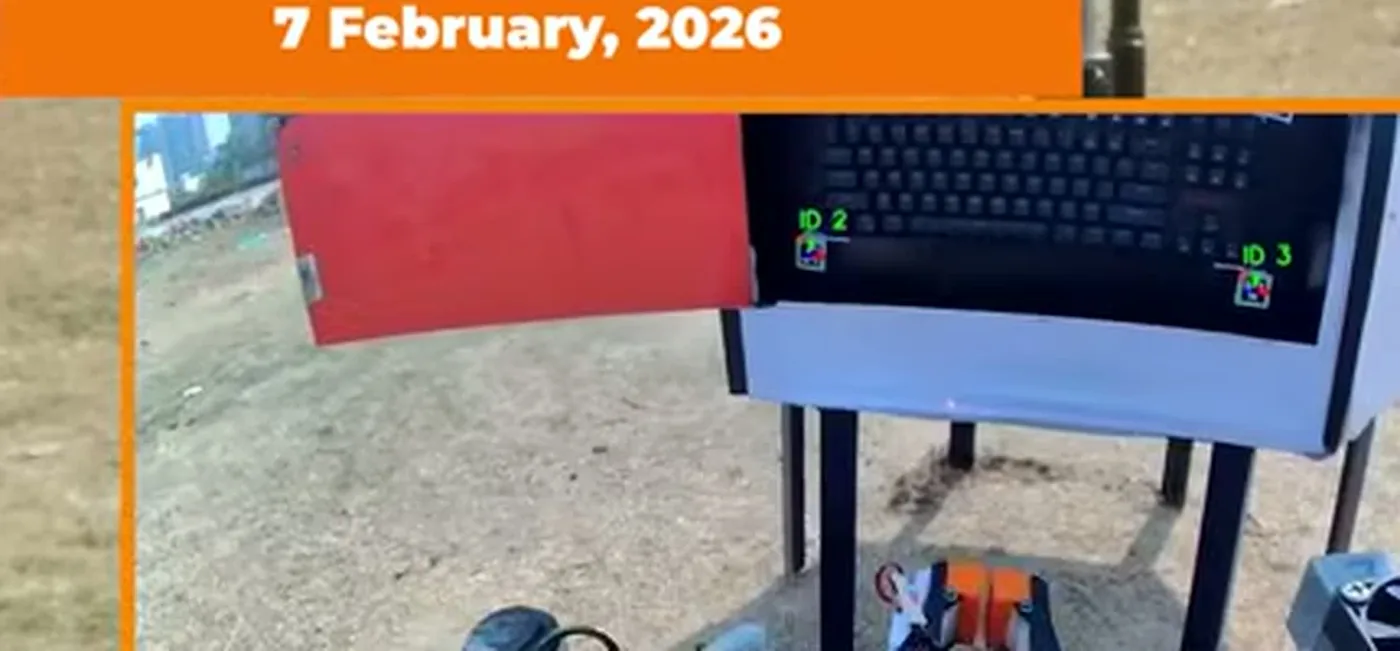
The typing method has been stable since 2023 and is worth copying in outline: register the arm to the keyboard with fiducials rather than by dead reckoning, solve inverse kinematics numerically, let the operator switch between teleoperation and trajectory control, and signal arrival on the dashboard. The 2025 version used a tag and a time-of-flight rangefinder; the 2026 version maps monocular vision to the arm frame S-UIU-2025-SAR S-UIU-2026-SAR.
Science. A wet laboratory on the rover, reporting a biomolecule verdict rather than a spectrum. The 2026 payload pairs an in-house Raman spectrometer, now with a deployment mechanism for direct-contact measurement, with a wet-chemistry laboratory running Benedict’s, ninhydrin, salicylate and ultraviolet fluorescence tests for carbohydrates, proteins, ammonia and chlorophyll S-UIU-2026-SAR. Sampling is a rotary collector to 15 cm with a quick-release cache, and the sample is delivered by the main arm. Contamination is handled by physical isolation rather than cleaning, and the assays were chosen so that none needs external heating, which removes a power spike and a burn hazard in one decision S-UIU-2025-ARC.
Communications. A dual-band video and data link on 2.4 and 5.8 GHz plus a 915 MHz telemetry link, validated at 2.5 km with four simultaneous camera feeds S-UIU-2026-SAR. The band history is a sequence of adaptations to the same range problem: 2.4 GHz in 2022, 1.4 GHz in 2023, then 915 MHz with 5.8 GHz video from 2024 S-UIU-2022-SAR S-UIU-2024-SAR. The rover carries an onboard gigabit switch with IP cameras, which is a different and more scalable topology than analogue video, and explains how four feeds are carried S-UIU-2026-SAR. The base station runs a directional and an omnidirectional antenna on a tripod mast.
Power, compute and operations. A 24 V 30 Ah lithium-ion pack, about 720 Wh, with more than three hours of runtime, a custom battery manager with remote telemetry and remote shutdown, distributed power with per-subsystem isolation, and a hardware kill switch S-UIU-2026-SAR. The team’s own site gives 35 Ah and a different chemistry, which conflicts with the film; the film is the better source. Compute is a Jetson AGX Orin for high-level work and microcontrollers for low-level control on a custom logic board, with differential positioning fused with an inertial unit and a claimed sub-3 cm localisation S-UIU-2026-SAR. The command station is a laptop, two portable monitors, a gamepad and a second controller, plus a rugged portable deck for field testing.
Mission performance
The 2022 profile was upside down: review 9th, science 19th, delivery 15th, while servicing and autonomy were mid-field S-URC22-SCORES. From there the team attacked one weak mission per year and stated the reason in the next film: new wheels and steering after 2022, real-time kinematic positioning after the 2023 autonomy collapse, a lower centre of mass and behaviour trees after 2024, and a mobility re-architecture plus a new arm after 2025 S-UIU-2024-SAR S-UIU-2026-SAR.
The 2025 season was the science year: 100 out of 100 and the Best Science Team Award, with autonomy at 56 and servicing at 42.4 holding the total to 6th S-URC25-SCORES S-UIU-OLD-ACH. The 2026 season inverted it. Science fell to 85 and 18th in the field while autonomy, servicing and delivery all reached the top three, and the total rose 74.5 points to a podium S-URC26-SCORES.
The 2017 result is the warning at the other end of the record: a rover that reached the field and scored nothing on any mission, for reasons no source explains S-URC17-SCORES.
Lessons for a first build
- Make the review film the design review. Five films in the same order, one subsystem per section, numbers spoken aloud, cost almost nothing and force the team to be able to state every subsystem once a year S-UIU-2022-SAR S-UIU-2026-SAR.
- Register the arm with fiducials, not dead reckoning. A tag and a rangefinder, or a monocular map into the arm frame, is a cheap way to hit a keyboard repeatedly S-UIU-2025-SAR S-UIU-2026-SAR.
- Isolate instead of clean. Physically separated sample zones are a simpler contamination answer than wash cycles, and they survived three design generations S-UIU-2024-SAR S-UIU-2026-SAR.
- Choose assays that need no heat. It removes a power spike, a burn hazard and a thermal-control problem in one decision S-UIU-2025-ARC.
- A driver per motor over a shared bus removes a single point of failure S-UIU-2025-SAR.
- A swappable mission interface answers the 50 kg and 70 kg rules by design rather than by removing bolts at the weigh-in S-UIU-2026-SAR S-URC27-RULES §2.a.
- An out-of-season competition is a test campaign. The Australian event added night operation, a 30 kg tow and an antenna drop that URC does not allow in rehearsal S-UIU-2025-ARC.
What remains uncertain
The stowed envelope, wheel diameter and width, arm reach and link lengths, motor and actuator part numbers, radio model and power, antenna gain and height, and positioning receiver model are all unpublished. No mass budget, power budget, margin policy or component mass breakdown exists for any year, and the single competition mass of 47.5 kg is self-reported on the team site with no second source S-UIU-SITE-AURION.
The team’s own site is unreliable for values: it reuses identical sentences across all five rover pages, states two competition results that contradict the official sheets, and disagrees with the films on arm degrees of freedom, suspension type and battery chemistry S-UIU-SITE-HOME S-UIU-SITE-AURION. The figures above come from the films and the score sheets. The 2022 suspension account is partly garbled in the film’s automatic captions, and no post-competition debrief exists for any season.
Team sources
- uiumarsrover.org, the team site, with a page per rover.
- Review film, 2026, the most complete statement of the current rover.
- Review film, 2025, the six-wheel rover and the science-award season.
- Australian Rover Challenge film, 2025, the out-of-season test campaign.
- Team channel, all five annual films.
- Sponsor release, 2026, the podium announcement.
Sources for this page
- S-URC25-SCORESURC2025 Official ScoresOriginal
- S-URC26-SCORESURC2026 Official ScoresOriginal Archived copy
- S-UIU-2025-SARUIU Mars Rover, SAR 2025 (video; AXIOS, rocker-bogie with rear differential bar, carbon chassis)Original
- S-UIU-OLD-ACH"Our Journey of Excellence", achievements page of the previous site (archived 2026-02-09)Original
- S-UIU-2026-SARUIU Mars Rover, SAR 2026 (video; AURION, 6-wheel to 4-wheel rocker transition, spring pivot, carbon-core wheel)Original
- S-UIU-2022-SARUIU Mars Rover TeamPrint copy
- S-URC17-SCORESURC2017 Scores (CDR + 4 missions)Original
- S-URC22-SCORESURC2022 Official ScoresOriginal
- S-UIU-UNITED-2026"UIU Mars Rover Team Secures 3rd Position Globally at URC 2026"Original
- S-UIU-2023-SARUIU MARS ROVER TEAMPrint copy
- S-UIU-2024-SARUIU MARS ROVER TEAMPrint copy
- S-UIU-2025-ARCUIU MARS ROVERPrint copy
- S-URC27-RULESUniversity Rover Challenge 2027 – Requirements and GuidelinesOriginal Archived copy
- S-UIU-SITE-AURIONAURION Rover (5th Gen), rover pageOriginal
- S-UIU-SITE-HOMEUIU Mars Rover Team, official site, home pageOriginal