Failures and interfaces
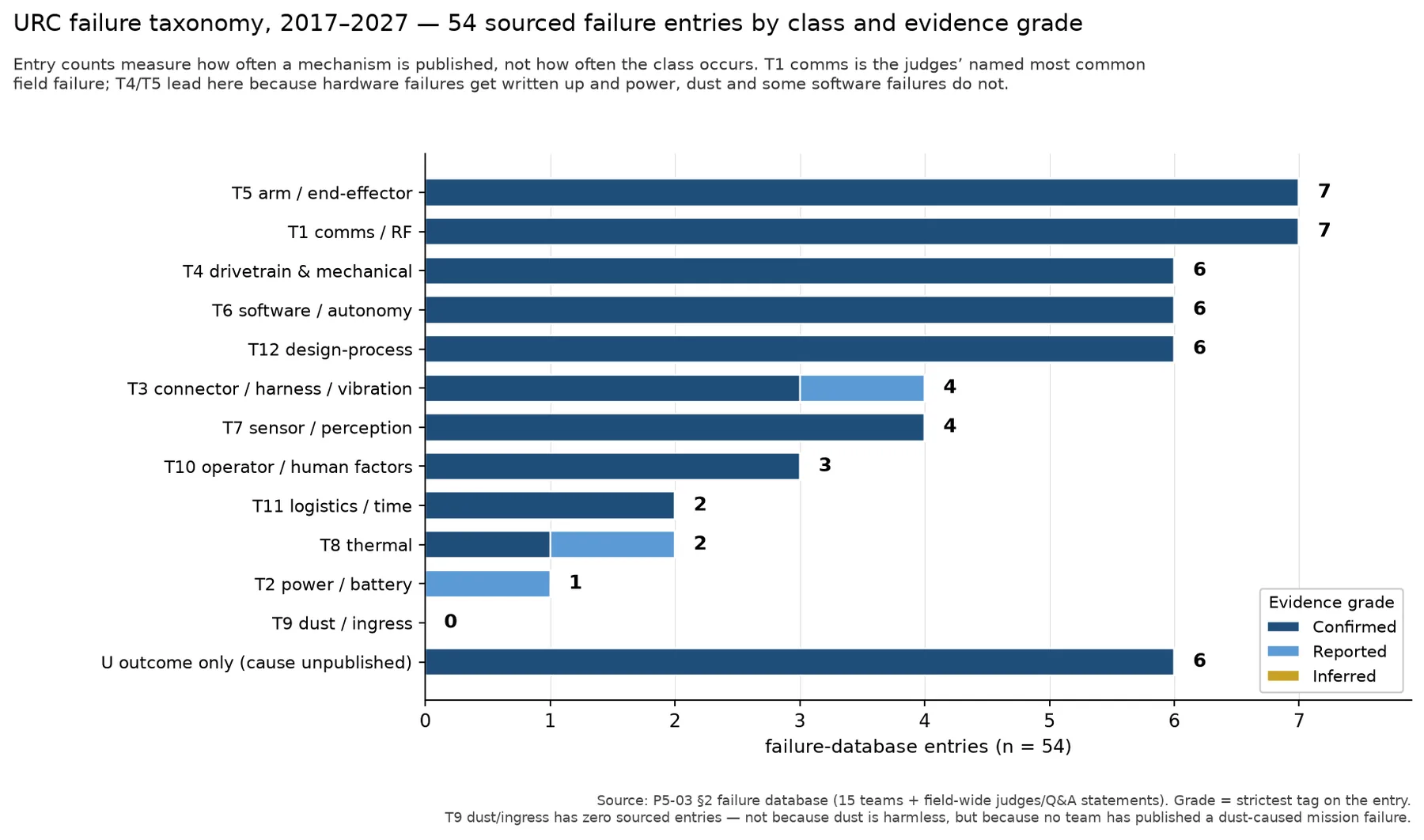
The failure record holds 54 sourced entries from 2017 to 2027: 48 with a named mechanism and 6 that record an outcome without a published cause. The interface matrix holds 66 boundaries between twelve subsystems, 37 of them high criticality. Together they describe the same thing from two directions: a failure is an interface that was not managed, and an interface is a place where one subsystem’s change becomes another’s redesign. The failure counts measure how often a mechanism gets published, not how often it happens.
Key takeaways
- Communications is the judges’ named most common field failure, and the record does not contradict them. It ties with the arm at 7 entries, and both sit ahead of drivetrain, software and design process at 6.
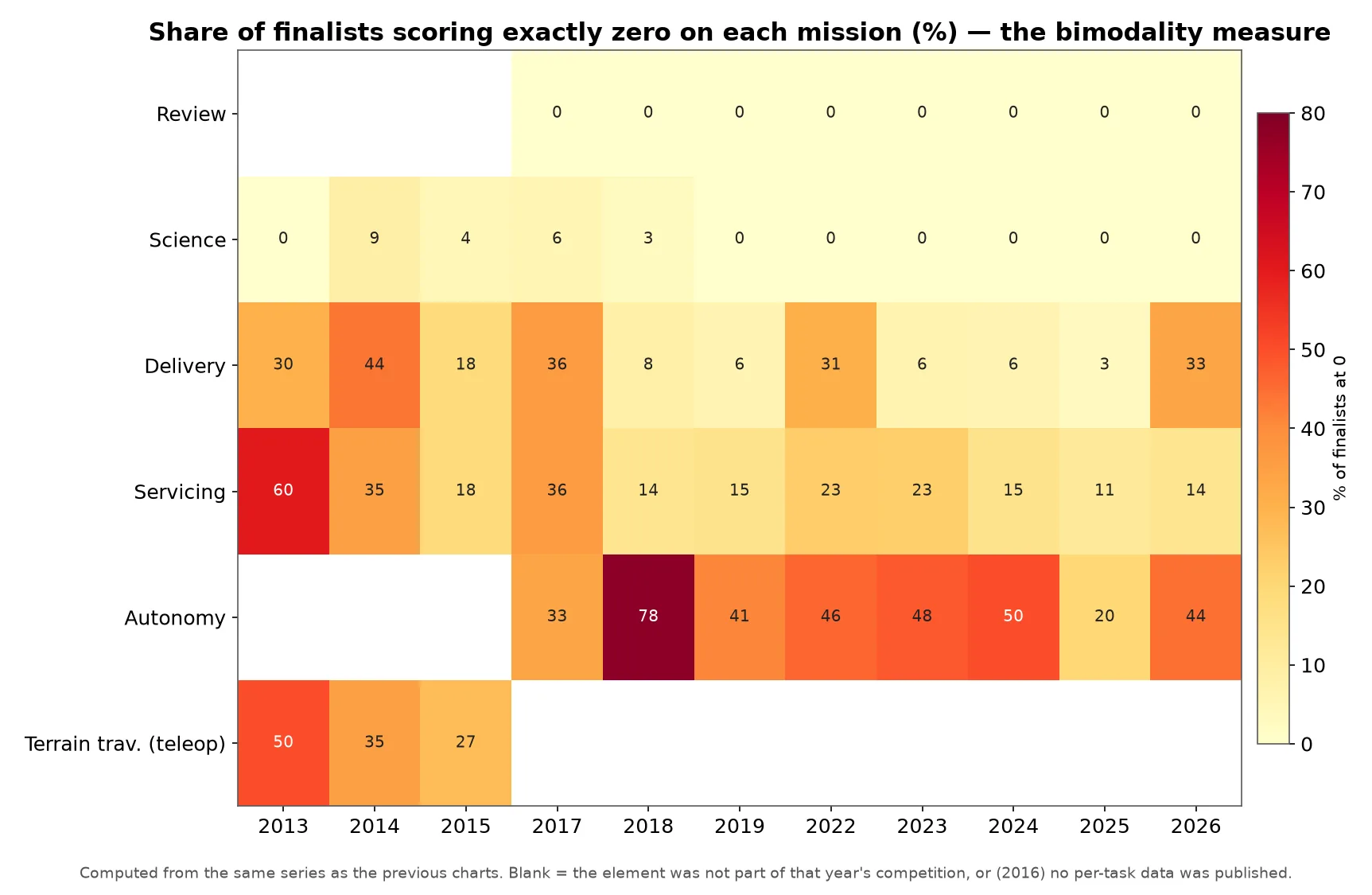
- The most expensive class is autonomy capability, not comms. About 610 of the roughly 945 mission points the field loses to zeros each year are Autonomy points.
- Zeros cluster into one broken rover. An Equipment Servicing zero multiplies the chance of a Delivery zero by 2.9 and of an Autonomy zero by 2.1.
- Coupling is concentrated. The arm, compute and perception each carry nine high-criticality interfaces; delivery carries one, because its risk is in the mission sequence rather than a new boundary.
The failure record
| Class | Entries | What breaks |
|---|---|---|
| Arm and end-effector | 7 | Joints, gearboxes, gripper contact, entanglement |
| Communications and radio | 7 | Link loss, antenna pointing, video drop |
| Drivetrain and mechanical | 6 | Suspension mounts, wheels, belts, auger |
| Software and autonomy | 6 | Planners, state machines, late stacks |
| Design process | 6 | Not finished, not tested, too much changed at once |
| Connector, harness and vibration | 4 | Loose connectors, cable damage, USB loss |
| Sensor and perception | 4 | Detection, localisation, camera placement |
| Operator and human factors | 3 | Procedure, sequence, command confusion |
| Logistics and time | 2 | Mission clock, sequence planning |
| Thermal | 2 | Overheating in a sealed box |
| Power and battery | 1 | Pack, contactor, distribution |
| Dust and ingress | 0 | No team has published a dust-caused mission failure |
| Outcome only | 6 | A zero or collapse with no published cause |
Of the 54 entries, 51 carry a primary grade and 3 a secondary one. The zero in the dust row is a finding about publication, not about dust: dust is a known hazard with no written post-mortem behind it S-URC-ADVICE.
What the classes cost
| Mission | Mean score when non-zero | Zeros a year | Points left to zeros a year |
|---|---|---|---|
| Delivery | 27.9 | 5.0 | 140 |
| Equipment Servicing | 36.3 | 5.4 | 196 |
| Autonomy | 45.5 | 13.4 | 610 |
| Total | ≈945 |
The yearly totals run 994, 1120, 1051, 450 and 1350 for 2022 to 2026. A team that zeroes Equipment Servicing also zeroes Delivery 44 % of the time, 2.9 times the base rate, and Autonomy 85 % of the time, 2.1 times the base rate. That is the signature of one rover-level failure taking several missions down, not of three independent misfortunes.
The exceptions matter. Of the 67 Autonomy zeros, 58 % are isolated: the rover worked everywhere else and could not complete the autonomous task. Only 11 % of Equipment Servicing zeros are isolated. Autonomy is therefore two problems in one column, a capability gap that is the largest persistent loss in the field and a rover-level fault that shows up alongside a mechanical failure.
The interface matrix
The twelve subsystems are joined by 66 interfaces, and every pair has at least one. Criticality is applied mechanically: a boundary is high if a change on one side forces a redesign, a re-test or a re-freeze on the other, or if a failure there alone loses at least 10 mission points or breaches a rule.
| Feature | Count or value |
|---|---|
| Interfaces | 66 |
| High criticality | 37 |
| Medium criticality | 25 |
| Low criticality | 4 |
| Most coupled subsystems | Arm 9, compute and perception 9 |
| Next band | Environment, systems, communications and mobility at 7 each |
| Least coupled | Delivery at 1 |
| Interface types | Mechanical, electrical, data, thermal and timing |
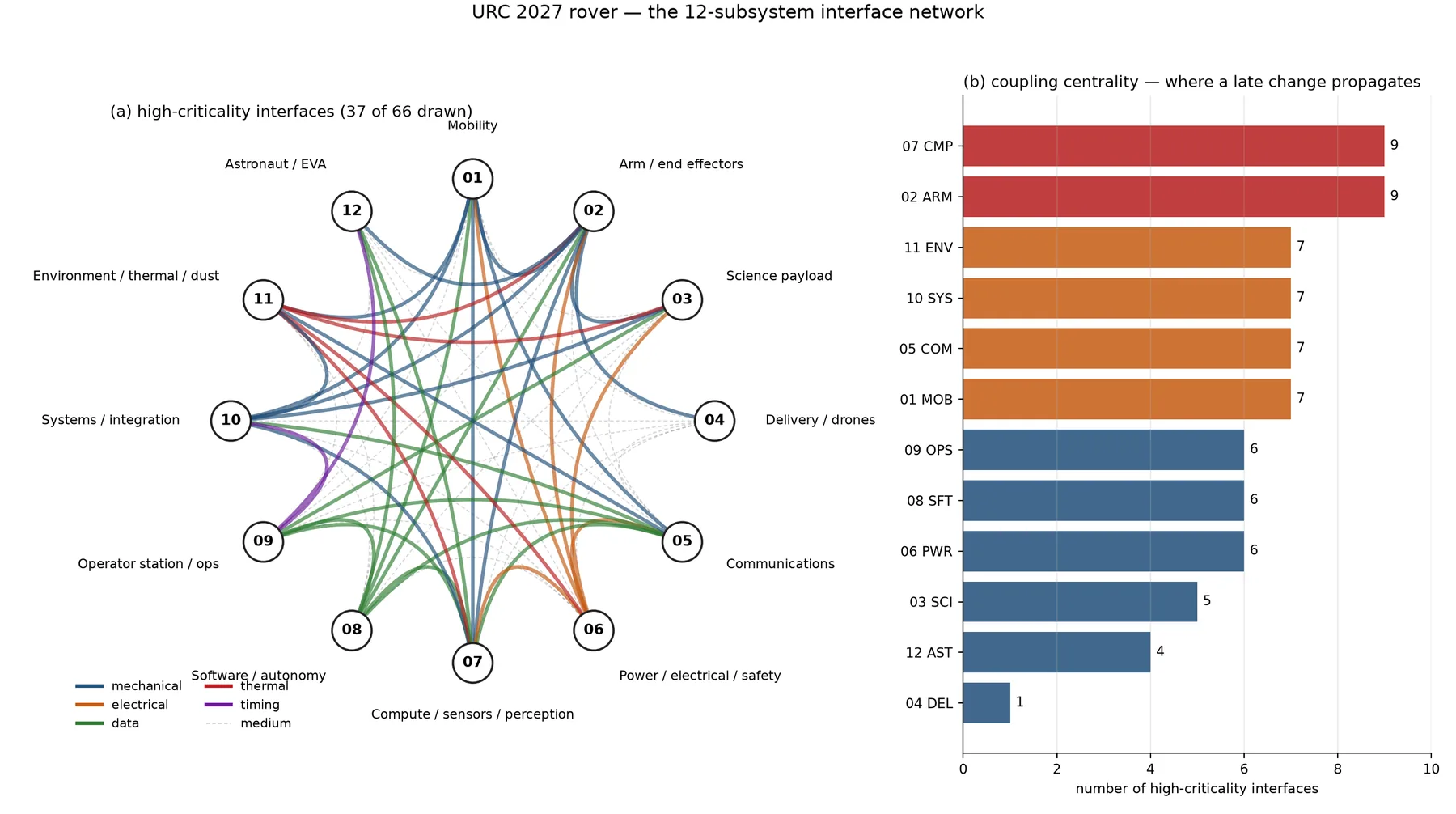
Three features carry most of the warning. The arm and compute are the most coupled subsystems, so deferring either decision is expensive. Every power interface except the thermal one is electrical, and the E-stop rule requires all power draw to cease on one button, which touches power, compute, communications, the arm and the astronaut interface at once S-URC27-RULES §2.a.v. Delivery has a single high interface, the arm’s 5 kg grasp, because it re-uses the existing boundaries rather than adding a new one.
The documented interfaces
The table lists the 41 interfaces that carry a named risk and a documentary trail; the matrix has 66 cells in total, and the remaining ones are recorded in the interfaces analysis.
The values on this page
| Statistic | Value | Definition | Period | Sample | Source | Chart and chapter |
|---|---|---|---|---|---|---|
| Failure entries | 54 | Sourced entries with a mechanism or outcome | 2017–2027 | 15 teams plus field statements | Analysis | Chart above; How rovers fail |
| Classifiable entries | 48 | A named mechanism or symptom | 2017–2027 | 54 entries | Analysis | How rovers fail |
| Interfaces | 66 | Boundaries between twelve subsystems | 2027 | 12 × 12 matrix | Analysis | Chart above; Interfaces and couplings |
| High interfaces | 37 | Redesign-forcing or 10-point boundaries | 2027 | 66 interfaces | Analysis | Interfaces and couplings |
| Highest coupling | 9 | High interfaces on the arm and on compute | 2027 | 66 interfaces | Analysis | Interfaces and couplings |
| Zero lift | 2.9× | Delivery zero given an Equipment zero | 2022–2026 | 162 team-years | S-URC-RESULTS | Zeros and consistency |
Evidence note
The failure counts are counts of publication: a class with seven entries is one that teams write up, not necessarily one that happens most. The judges name communications as the most common cause of a motionless rover but publish no frequency, so the statement is sourced and the number is not. The interface matrix is a structured judgement by the analysts, not a measurement, and the delivery node is the weakest of the twelve because it has no dedicated study. The zero co-occurrence figures are associations across 162 team-years and do not establish which failure caused which.
Sources for this page
- S-URC-ADVICEURC Advice (judges' systems-engineering lessons)Original Archived copy
- S-URC27-RULESUniversity Rover Challenge 2027 – Requirements and GuidelinesOriginal Archived copy
- S-URC-RESULTSURC official scores 2022–2026, compiled CSVPrint copy