Delivery, payload handling and drones
Delivery is a staged mission: the rover finds, picks up, carries and delivers objects over terrain of increasing difficulty, and it must reach a minimum score in Stage 1 before Stage 2 opens. Objects reach 5 kg, the course reaches a kilometre, and line of sight is not guaranteed for more than half of it. This page is a synthesis rather than a dedicated study. No comparable published account of the 2027 Delivery mission or its drones exists, so the evidence is drawn from the 2027 rules and Q&A, the team dossiers, and the arm and astronaut studies. It is thinner than the pages around it, and it says where.
Key takeaways
- The Stage-1 gate is the mission. Failing the minimum ends the run, and in 2026 the gate was 40 of 100. The cheap tasks have to be banked before the expensive ones are attempted.
- The object envelope is a gripper specification. A wide-opening, current-limited parallel gripper with a hook covers every documented task, and a mini-rover is explicitly prohibited.
- The drone is optional. It is capped at 5 kg with an inert dummy mass, allowed in Delivery and Autonomy only, and full points are possible without one, so it never belongs on the critical path.
- Delivery is a link problem before it is an autonomy problem. The rover may be teleoperated throughout, but the link has to survive a kilometre of terrain that blocks line of sight.
What the subsystem must do
Each stage has a fixed time and several tasks. The team must achieve a specified minimum score on Stage 1 to proceed, and remaining Stage-1 time is added to Stage 2, for a total on-course time of 30–60 minutes S-URC27-RULES §1.c.i. Objects are up to 5 kg, smaller than 40 × 40 × 40 cm, with a graspable feature no larger than 7.5 cm, and they may be small hand-held items or instruments, rocks, or supply containers, grasped by a handle or by a natural feature S-URC27-RULES §1.c.iii.
The course runs up to 1 km from the start gate, across soft sand, gravel, rough stone, boulder fields, vertical drops and steep loose slopes, and the total path may exceed the kilometre S-URC27-RULES S-URC27-QA §1.c.ii RQ13. Line of sight is “not guaranteed for more than 50 % of the course”, and later tasks are deliberately placed out of it S-URC27-RULES §3.d.ii. Working GNSS is described as essential, but the coordinates are only approximate, so the rover has to search at the waypoint and identify the right object S-URC27-RULES §1.c.iv.
The rulebook lists the task families a team can expect, and the order is not known in advance: open a box with a hinged lid, pick up and deliver an object, read a sign carried by an astronaut or placed in the field, find equipment in a large search area, find objects in an area with poor radio reception, and use approximate GNSS coordinates for pickup and delivery S-URC27-RULES §1.c.iii–iv. A drone may help. No mini-rover or other mobile deployable may be used S-URC27-RULES §1.c.i.
The 2027 change is small and easy to miss: the 2026 rule listed following a marked path as a possible task, and the 2027 rule does not S-URC26-RULES S-URC27-RULES §1.c.iii §1.c.iii. Everything else about the object sizes, the range and the scoring basis is carried forward.
The numbers that size the design
The mission numbers are rules. The gripper strengths and the time arithmetic are inferences from the arm analysis and from the 2026 course, and they are labelled as such.
| Quantity | Value | Basis |
|---|---|---|
| Object envelope | up to 5 kg, under 40 × 40 × 40 cm, grasp feature under 7.5 cm | S-URC27-RULES §1.c.iii |
| Course range | up to 1 km; total path may exceed 1 km | S-URC27-QA RQ13 |
| Mission time | 30–60 minutes, with fixed time per stage | S-URC27-RULES §1.c.i |
| Stage-1 gate | a specified minimum; 2026 used 40 of 100 | 2027 value not published; 2026 proxy S-URC26-DM |
| Placement tolerance | 2026 required the object within 20 cm, with no rover part touching | 2027 value not published; a useful design target S-URC26-DM |
| Drone mass | 5 kg or less, including the inert dummy mass | S-URC27-RULES §2.b.v–vii |
| Point density | 1.67–3.33 points per minute across a 30–60 minute mission | 100 points over the stated window; the 2026 course was 1.82 S-URC26-DM |
| 2026 Delivery score | mean 22.9, median 20, twelve zeros of 36 | Official scores S-URC26-SCORES |
Design space, in one table
| Decision | Options | What the evidence recommends |
|---|---|---|
| Payload carrier | arm only · cargo box or crane · towed cart · mini-rover · drone only | Arm only. Every documented top team carries with its arm, and a mini-rover is prohibited |
| End effector | two-finger parallel · hook or pin · dual head · swappable heads · suction | Two-finger parallel with 100–110 mm opening, plus a hook for latches and drawers |
| Search | mast camera with map coverage · drone · ground pattern · learned detector | Mast camera with map-driven coverage and an object detector; a drone is optional |
| Drone | none · commercial quad · custom quad | None for a first build, or a commercial quad under 5 kg; never on the critical path |
| Autonomy | teleoperation · GNSS waypoints with object detection · full autonomy | Teleoperation with GNSS waypoints and an object detector. Delivery does not require autonomy |
The Stage-1 gate is the mission
The stage structure turns the first minutes into the highest-value minutes of the run. A rover that fails the gate scores whatever it banked in Stage 1 and stops, so a slow start is not a slow mission but a short one. In 2023 the field median was 15 of 100 S-URC23-SCORES.
The 2026 course is the only published proxy for the shape of the scoring. Stage 1 ran 35 minutes for 70 points split 10, 10, 30 and 20, with a 40-point gate; Stage 2 added 10 and 20 points, a 20 cm placement tolerance, a 20 m wreckage radius and cones about 100 m apart S-URC26-DM. None of those values is a 2027 rule, and the 2027 stage durations, the gate and the task weights are all unpublished.
The team record shows what a gate failure looks like over several seasons. Missouri S&T scored 80 in 2022, 15 in 2023 and 15 again in 2024, then 70 in 2025 and 100 in 2026 S-URC22-SCORES S-URC23-SCORES S-URC24-SCORES S-URC25-SCORES S-URC26-SCORES. The 2023 account is explicit: the rover ran out of time in Stage 1 without enough points to proceed, and the team blamed its inability to locate a specific rock through its cameras S-MST-NEWS2023. The 2024 failure was different and equally instructive: mechanical faults in the rover-side signals and in the vertical axes of the arm S-MST-NEWS2024. One season was a perception failure, the next a mechanism failure under driving loads, and both ended the mission before the expensive tasks.
The same spread appears across the field. Monash went 70, 15, 80, 71 and 76; WVU won in 2023 with 90 and in 2025 with 80 but fell to 52 and 61 in the other years; UIU went from 18.75 to 62 S-MONASH-IEEE-RAM S-WVU-SAR2024 S-UIU-2026-SAR. Between one and twelve teams score exactly zero each year, and the distribution is not graded: a mediocre run is not a safe plan. Missouri S&T reached 100 in 2026, and it is the same team that scored 15 twice, so the difference between a zero and a win is mostly whether the first three tasks worked.
The object envelope is a gripper specification
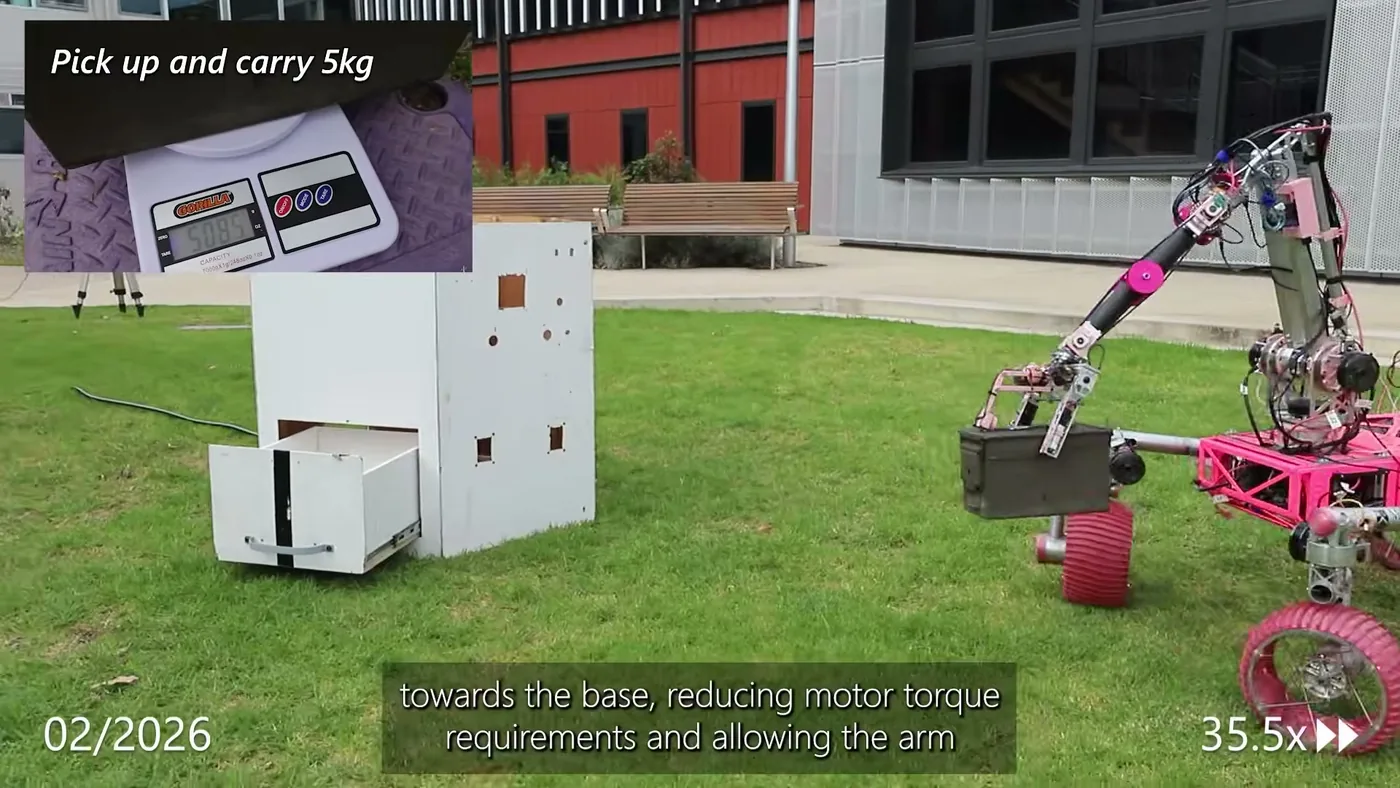
The rules give a mass, a box and a grasp feature, not a shape. That is what makes a single-purpose hook a bad design and a wide gripper the starting point. The arm analysis puts numbers on the classes: a jaw of at least 60 mm and a grip of at least 40 N for a 5 kg cache, at least 70 mm and 60 N for a 0.91 kg hammer, and a 100–110 mm opening to cover the cache handle, the hammer shaft, a valve lever and a hose fitting. Those strengths and openings are inferences from the arm study, not published figures.
Two details decide whether the grasp survives the drive. The first is that objects can be grasped by a natural feature, so the grip has to work on a rock as well as on a handle, which argues for a closed jaw with a mechanical stop rather than a friction pinch. The second is the 2026 placement tolerance of 20 cm, which means the mechanism has to place the object rather than throw or drop it. No rover part may touch the object once placed S-URC26-DM.
The end effector is therefore the same one the Equipment Servicing mission needs, with one addition: a hook or pin for latches and drawer pulls. That sharing is a systems decision rather than a Delivery decision, and it is worth taking, because a second end effector costs mass at the wrist and a second calibration.
The drone, capped at 5 kg
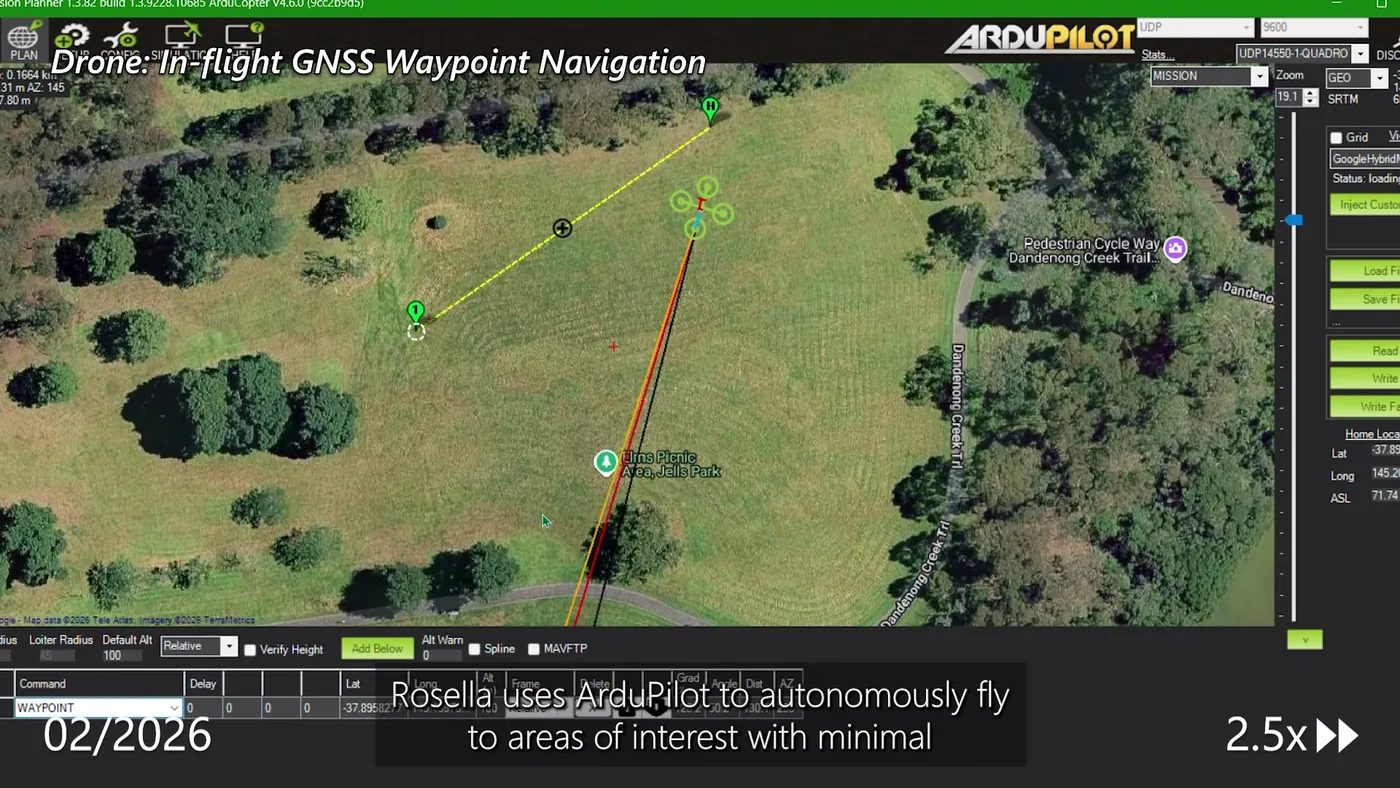
A drone is optional and full points are possible without one S-URC27-RULES §2.b.i. If one is flown, it must be rotary-wing and able to hover, it must start from the designated landing pad, and it must weigh 5 kg or less including an inert dummy mass equal to its battery mass, carried at all times; a spare battery is not a dummy and high wind does not waive the requirement S-URC27-RULES §2.b.iii–vii. It may assist Delivery and Autonomy only, never Astrobiology or Equipment Servicing, and in Autonomy it must land before the rover proceeds S-URC27-QA S-URC27-RULES §1.e.xiv RQ9. The constraints are traced as REQ-DRN-002 for the mass, REQ-DRN-006 for the missions in which it may fly, and REQ-DRN-011 for the requirement that the plan must not depend on it.
Three operational costs sit behind that envelope. A human battery swap is an intervention, and interventions are additive at 20 % each S-URC27-QA S-URC27-RULES §3.e RQ14. The pilot sits in the C2 station with no view, so a field spotter is the only line of sight, and the base needs at least 25 m of cable S-URC27-QA DQ2. And the airspace rules apply in full: registration above 250 g, Remote ID, a TRUST certificate, below 400 ft (120 m) above ground level, class G airspace, and no flight in a National Park S-URC27-RULES §2.b.vii–xii. The rules strongly suggest a drone that can operate in 48 km/h wind, which implies a top speed of at least 64 km/h, but that is a suggestion rather than a requirement.
The team record is thin and mostly negative. Missouri S&T’s Zephyr never flew at competition in 2024, while Noctua in 2026 scouts and acts as a signal repeater; WVU uses a commercial DJI Mavic 2 Pro; UIU’s drone identifies rocks and reads signs but does not deliver S-MST-SITE-ATHENA S-WVU-SAR2024 S-UIU-2026-SAR. No team is documented flying a relay that changed the outcome. The honest reading is that a drone buys time and reduces risk on search and sign-reading tasks, and that it is not a scoring line of its own.
Interfaces that bite
- Arm and end effector. One arm carries 5 kg, opens a hinged box, reads a sign and, in Autonomy, fetches a hammer. A 100–110 mm gripper with swappable tips is the common denominator, and the same wrist has to pass through a 1.2 m cube when stowed.
- Communications. Up to 1 km, with line of sight broken for more than half the course, makes Delivery a link problem even though it is teleoperated. Both operators sit inside a metal trailer with no view, and every intervention costs 20 %.
- Mobility and power. Soft sand, gravel, boulder fields, vertical drops and steep loose slopes up to 1 km, with a 5 kg object raising the centre of gravity. At up to 60 minutes this is the longest mission.
- GNSS. Approximate coordinates plus a local search means the navigation solution has to survive a waypoint that is wrong by tens of metres, and the team must run its own base station because there is no correction service on site S-URC27-QA RQ11.
What fails
The failure record is short, because most of it is buried in post-season notes rather than published. Three mechanisms account for most of the zeros.
- Object finding. A rover that cannot pick the required rock out of a boulder field cannot start. Missouri S&T’s 2023 account is the clearest statement of it S-MST-NEWS2023.
- Mechanism failure under driving load. The 2024 failure in the arm’s vertical axes happened in Delivery rather than in Equipment Servicing, which is the point: a mechanism that works while stationary can fail on a slope S-MST-NEWS2024.
- Time. The gate converts a slow start into a zero, and the 2023 field median of 15 shows how common that is S-URC23-SCORES.
Shortlist for a first build
| Item | Choice | Why |
|---|---|---|
| Carrier | The arm, with no cargo mechanism | Every documented top team does it, and a cargo box adds mass and failure modes for no rule requirement |
| End effector | Two-finger parallel, 100–110 mm opening, plus a hook | Covers a handle, a rock, a hammer shaft and a latch with one wrist |
| Grasp | Closed jaw with a mechanical stop, grip force monitored | A natural-feature grasp cannot rely on friction alone over rough ground |
| Placement | Designed to 20 cm, placed rather than dropped | The 2026 tolerance is the only published figure and a sensible target |
| Sequence | Bank the cheap Stage-1 tasks first, with a timed rehearsal | The gate makes the first minutes worth more than their face value |
| Navigation | GNSS waypoints plus an object detector, teleoperated | Delivery does not require autonomy, and the operator can resolve what the detector cannot |
| Drone | None, or a commercial quad under 5 kg with a pilot and a spotter | Full points are possible without one, and the cap leaves little margin |
Open problems
- What are the 2027 stage durations, the Stage-1 gate and the task weights? All are unpublished and promised before the competition, and all three decide the task order.
- What do the objects actually weigh and measure? The rules give limits, not objects. A mock set built to 5 kg, 40 cm and a 7.5 cm feature is the only way to test a grasp.
- How much force does a hinged lid need? No figure is published for the box lid, the latch or the drawer.
- What is the real link margin out of line of sight? The course is the test, and it is not available before the event.
- Does a drone earn back its mass, its pilot and its intervention risk? No team documents a case where it did, and no team documents a case where its absence cost a mission.
- What is the placement tolerance for 2027? The 20 cm figure is a 2026 value and may change.
Further reading
- Missouri S&T, Monash, WVU and UIU carry the delivery record and the drone evidence.
- Delivery maps the mission tasks to the design.
- Arm and end-effectors sizes the gripper and the carry.
- Interfaces and couplings works the payload, link and mass chains.
Sources for this page
- S-URC27-RULESUniversity Rover Challenge 2027 – Requirements and GuidelinesOriginal Archived copy
- S-URC27-QAURC2027 Questions & Answers (updated through 2026-10-11)Original Archived copy
- S-URC26-RULESUniversity Rover Challenge 2026 – Requirements and GuidelinesOriginal Archived copy
- S-URC26-DMURC2026 Delivery Mission Course rules (used only as a 2026 proxy; not a 2027 rule)Original
- S-URC26-SCORESURC2026 Official ScoresOriginal Archived copy
- S-URC23-SCORESURC2023 Official ScoresOriginal
- S-URC22-SCORESURC2022 Official ScoresOriginal
- S-URC24-SCORESURC2024 Official ScoresOriginal
- S-URC25-SCORESURC2025 Official ScoresOriginal
- S-MST-NEWS2023MRDT Winter 2023 Newsletter (PDF, 4.2 MB), URC 2023 review (belt break, Stage-1 delivery failure, rain delay) and 2024 design intentOriginal
- S-MST-NEWS2024MRDT Newsletter Winter 2024–25 (PDF, 7.5 MB), URC 2024 review with failure forensics, 2025 design update, 88 active membersOriginal
- S-MONASH-IEEE-RAMA Tale of Two Rovers: How Different Philosophies Foster Innovation in the 2023 University Rover ChallengeOriginal
- S-WVU-SAR2024Team Mountaineers System Acceptance Review 2024 (rover "Heimdall"): dual-band 2.4 GHz + 900 MHz, 90°/120° sector antennas, 250 m / 1 km tested, antenna and radio budget linesOriginal
- S-UIU-2026-SARUIU Mars Rover, SAR 2026 (video; AURION, 6-wheel to 4-wheel rocker transition, spring pivot, carbon-core wheel)Original
- S-MST-SITE-ATHENAAthena (2026) rover page, compact suspension, 3D-printed wheels, hub motors, STM32/CAN controllers, simulator arm, LiDAROriginal