Team browser
The browser is the census in card form: 70 records, each carrying a tier, a university, a country, a finals count and a best rank. It exists because the census table answers questions about columns and the browser answers questions about teams. Every card that has a profile behind it links through to that profile.
Key takeaways
- The browser holds two kinds of record. A census team has at least one score-sheet row; a registered team has none and is marked as registered on its card S-CENSUS.
- Fifty-one records carry a profile. The other nineteen are census teams whose public record is too thin to support one.
- Tier and finals count are the two fields worth reading first. Tier summarises the results record; finals count says how much of that record exists.
- A card without a profile is not a weak team. It is a team that published almost nothing.
What a card carries
Four lines, in a fixed order: the tier, the team name, the university and country, and the finals record. A card with a profile is a link, and the whole card is the target. A card without one is plain text and looks the same otherwise.
The tier label follows the rule on the census page: results first, with documentation able to move a team one band. The finals line reads either the number of seasons with a mission score and the best rank, such as 5 finals and best 1, or the words “No finals result” for a team that registered without recording one.
The browser
The browser filters by tier and country and searches team, university and country. Cards sort by tier and then by team name, so the Tier-A programmes appear together at the top of an unfiltered list. Each card with a profile opens the team dossier.
Reading the two numbers on a card
The finals count and the best rank answer different questions, and the gap between them is usually the interesting part.
The finals count is the number of seasons in which the team recorded a mission score, not the number of seasons it appears on a score sheet. MIST Mongol Barota carries five seasons on the sheets and two finals, because three of its rows hold a SAR score and no mission score S-CENSUS. UBC Rover carries a profile with no finals at all: its single row is a 92.64 SAR in 2025 S-URC25-SCORES.
The best rank is the lowest finals position the team has reached in any of the five seasons. It compresses five seasons into one number, so it rewards a single good year. AGH Space Systems has a best rank of 1 and three finals; IMPULS has a best rank of 5 and two finals; both sit above teams with longer, steadier records S-CENSUS.
By country
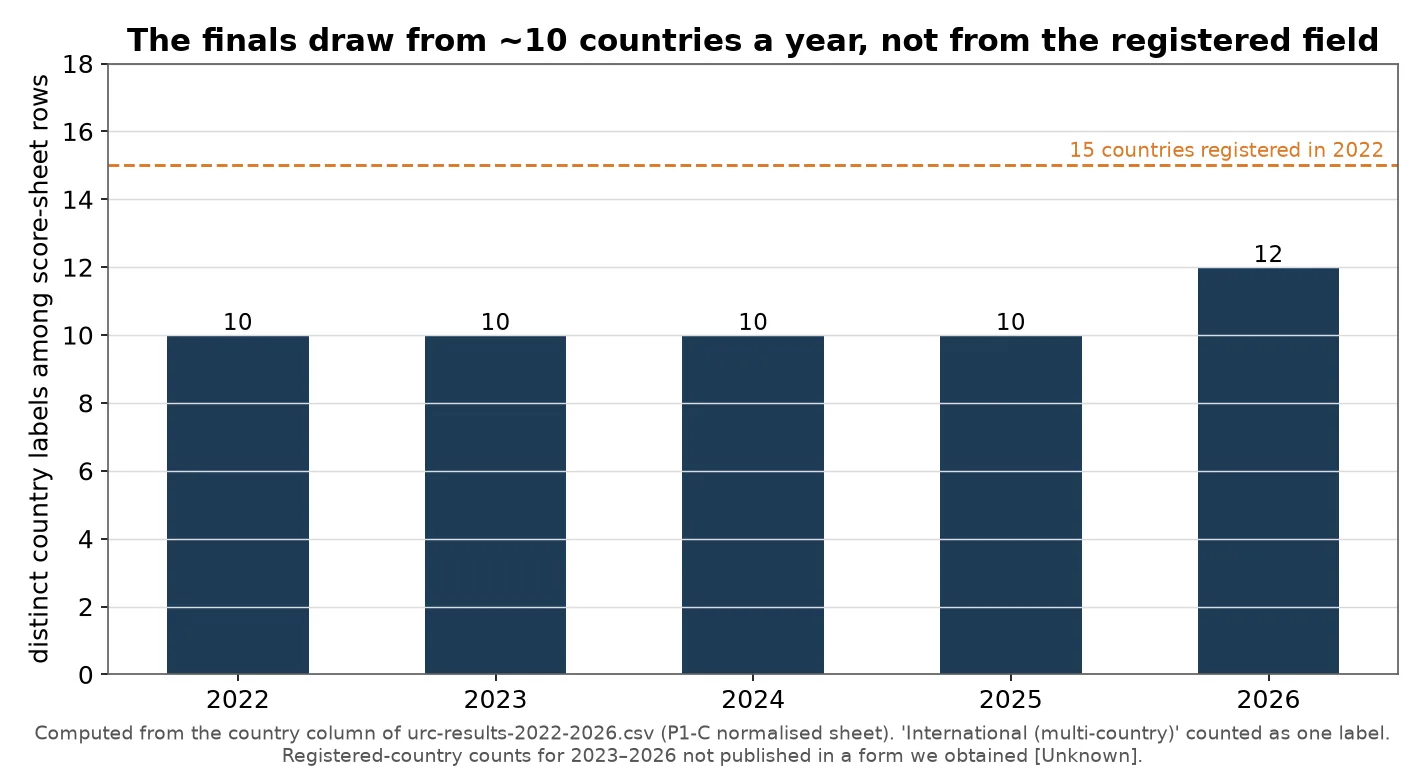
Fifteen country labels appear in the census and 14 of them in a finals field. The United States supplies 21 of the 68 teams, followed by India with 8, Poland, Bangladesh and Canada with 7 each, and Türkiye with 5; the remaining nine labels carry two teams or fewer, including two multi-national programmes S-CENSUS.
The country filter is a convenience for finding teams, not a performance predictor. Within-country spread is larger than between-country spread: the American teams alone run from first to 32nd, and the two Universidad de los Andes programmes, Ceres and Robocol, finished 21st and 22nd in 2025 and 2022 respectively.
From a card to a dossier
A profile follows a fixed order: identity and results, rover generations, subsystems, mission performance, lessons for a first build, what remains uncertain, and the team’s own sources. The results table at the top of a dossier is the same data as the card, so the card can be confirmed against the engineering text.
The dossier index groups all 51 profiles by tier and lists the nineteen census teams that have none. The practical route runs from a Tier-A programme, which shows a complete architecture, to a Tier-B or Tier-C programme at the same score level as the design target, which is the closer comparison.
Where to go next
- The 68-team census carries the same records as a filterable table with the tiering rule.
- Team dossiers lists the 51 profiles by tier.
- Results explorer, 2022–2026 shows the per-mission scores behind each card’s totals.
- The URC landscape explains what the tiers mean for a first build.
Sources for this page
- S-CENSUSURC team census, master index (68 teams, 187 team-year rows, tiers, documentation test)Print copy
- S-URC25-SCORESURC2025 Official ScoresOriginal