West Virginia University: Team Mountaineers
West Virginia University won in 2023 with 425.35 points, the highest total of that field, and has finished 1st, 2nd, 2nd and 4th since. It is the most completely documented programme in this field: a preliminary design review and a system acceptance review in four consecutive years, a science plan, published budgets, three years of CAD, three years of code and a systems-engineering presentation. It is also the clearest case of one mission deciding a season, because Equipment Servicing has scored 2nd, 3rd, 10th and 10th.
What this team shows
- Documentation can be a repeatable process. The same five document types appear across four years while the rover changes completely, which is why its design rationale is checkable at all S-WVU-SAR2023 S-WVU-SAR2026.
- Mass discipline works when it is structural. A 20 kg cut from 2022 to 2023 came from changing chassis construction and wheels, not from shaving brackets, and produced a 33 kg champion S-WVU-SAR2023.
- Equipment Servicing is a reliability mission, not an arm-capability mission. Both bad seasons were interconnect failures: communication losses in 2025 and a damaged USB-C cable in 2026 S-WVU-NEWS2025 S-WVU-NEWS2026.
- Autonomy improved by moving it off the drone and onto the rover, and scored 14, 56, 70, 84 and 86 across five seasons S-URC22-SCORES S-URC26-SCORES.
Identity and results
| Year | Rover | Total | Rank | SAR | Science | Delivery | Equipment | Autonomy |
|---|---|---|---|---|---|---|---|---|
| 2022 | ASTRO | 268.67 | 10 | 90.97 | 96.00 | 42.50 | 25.20 | 14.00 |
| 2023 | Wanderer | 425.35 | 1 | 94.35 | 100.00 | 90.00 | 85.00 | 56.00 |
| 2024 | Heimdall | 391.80 | 2 | 97.80 | 88.00 | 52.00 | 84.00 | 70.00 |
| 2025 | Daedalus | 396.17 | 2 | 93.17 | 96.00 | 80.00 | 43.00 | 84.00 |
| 2026 | Deimos | 376.70 | 4 | 96.75 | 94.00 | 61.00 | 38.95 | 86.00 |
WVU qualified for the finalist field in all five years, and the review was never the binding constraint: its worst review score, 90.97 in 2022, still ranked 7th, and it was 1st in 2024 and 2026 S-URC22-SCORES S-URC24-SCORES S-URC26-SCORES. That matters for a first build, because a strong written and filmed submission is something a student team can build and sustain.
The relative position fell while absolute scores stayed high, because the field improved faster. Missouri S&T moved from 370.71 in 2022 to 469.57 in 2026; WVU’s own review and autonomy scores in 2026 were the best in the field, and it still finished 4th S-URC22-SCORES S-URC26-SCORES.
Rover generations
2022: ASTRO. The first finals rover: a chassis plate on a differential double-bogie suspension, in-hub wheel mounts with printed tyres, a parallel SCARA manipulator on a lead-screw lift, cycloidal gearboxes at 420:1, a compliant clamping end effector, a 2.4 GHz primary link with an automatically oriented base antenna and a 900 MHz backup, and a science package using vacuum tubes, peristaltic pumps, a centrifuge and a visible-light spectrometer. It placed 10th with Science 96 and Autonomy 14 S-WVU-YT-SAR2022 S-WVU-ROVER2022.
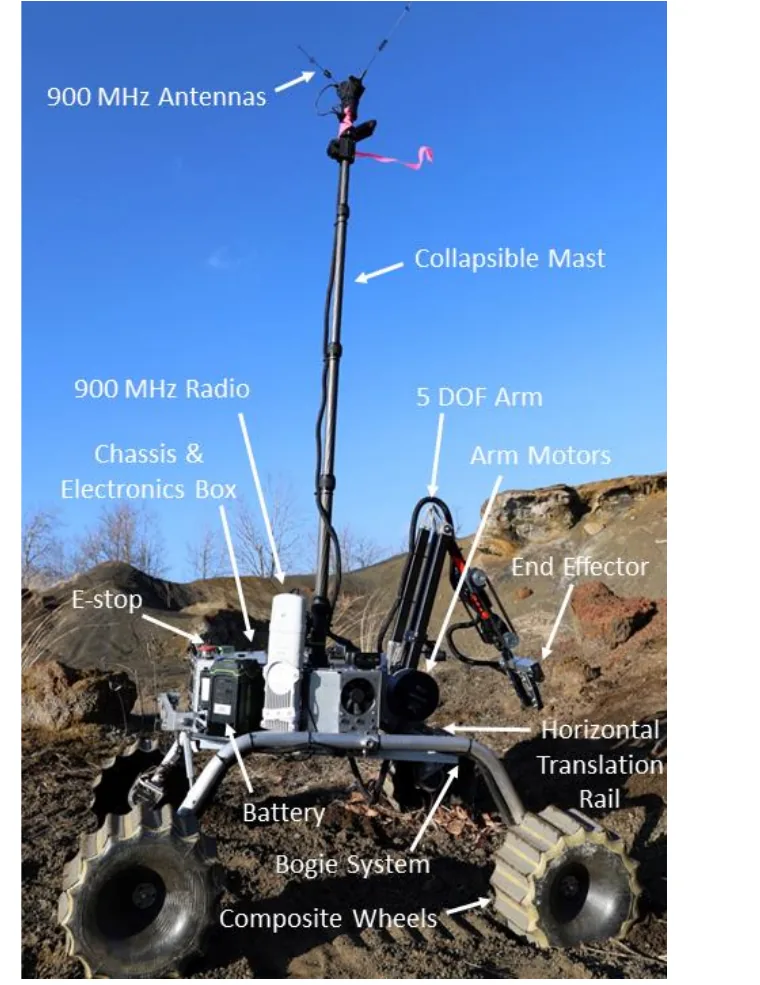
2023: Wanderer, the champion. A ground-up replacement: a semi-monocoque sheet-metal chassis with a triangular box tying the three suspension mounts together, tubular struts carrying the arm load into the suspension, differential-bogie suspension, and carbon-fibre and Kevlar composite wheels on in-hub brushless motors. The arm is a five-degree-of-freedom palletiser with a 500 mm horizontal rail, 8 kg lift at full extension, 54 N grip and a 0.5 m² working floor. Power is two 40 V and two 12 V packs through a custom distribution board with the E-stop on a battery-monitoring board. The rover is 33 kg, 20 kg lighter than ASTRO S-WVU-SAR2023 S-WVU-PDR2023.
2024: Heimdall, a high-risk redesign. A split-body semi-monocoque chassis of two compartments linked by a bearing, each half rolling independently to keep four wheels in contact, with a central hinge that let the rover fold inside the 1.2 m cube. The consequential change was whegs: a five-spoke aluminium hub with five composite feet and rubber treads, with the drive motors in pods below the chassis for ground clearance. Power moved to three hot-swappable 40 V packs of 5 Ah, nominal 600 Wh, and autonomy moved from the drone to the rover. It lost the title by 0.96 points with Delivery the largest gap S-WVU-SAR2024 S-URC24-SCORES.
2025: Daedalus. The split body and centre bearing were kept and the details that limited 2024 were changed: whegs grew to 24 inches with one folding spoke to stay inside the size box, speed rose to 1.6 m/s and ground clearance to 34 cm; the arm became a five-degree-of-freedom palletiser with a composite four-bar linkage, 9.4 kg mass, 10 kg lift, 70 N grip and a 100 by 55 cm cylindrical workspace; a Jetson Orin Nano and a Livox LiDAR with inertial odometry were added; and comms became a 2.4 GHz primary with 70 cm amateur packet radio for low-rate control and a 433.25 MHz analogue television link for video S-WVU-SAR2025. Delivery went from 4th to 1st and Equipment from 3rd to 10th.
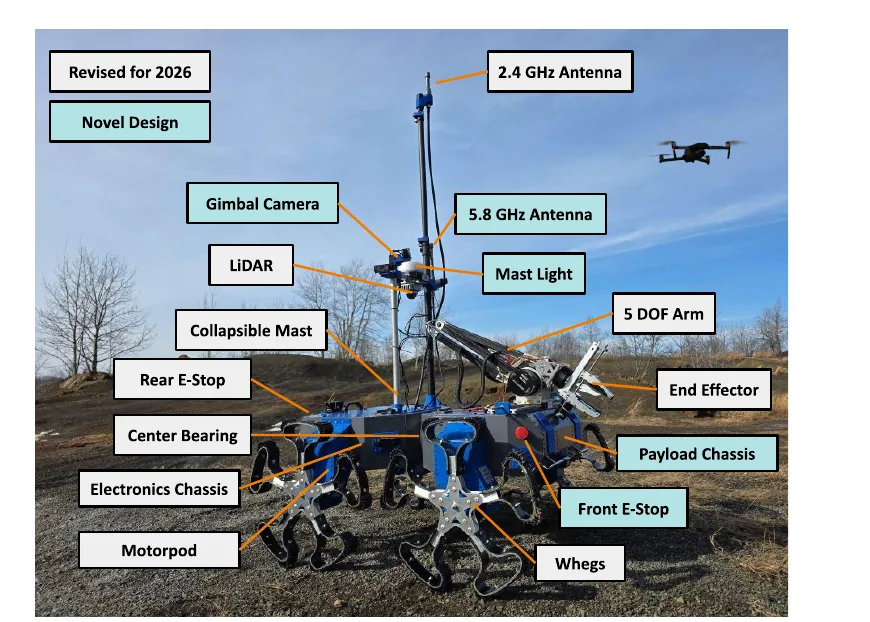
2026: Deimos, integration and simplification. A new chassis geometry with 20-inch whegs that fit the box without folding mechanisms, one integrated payload chassis that removes the mission-day swaps, a redesigned arm rail with limit switches, a quick-swap gripper with 0.015 to 220 N force sensing and an embedded linear actuator for key presses, a wrist-mounted USB-C cable, two 40 V 4 Ah packs, and a tri-band radio set S-WVU-SAR2026. Its mass is not published, but it carried the best review and a tied-best autonomy score to 4th.
Subsystems
Mobility. Four driven wheels, one motor per wheel, skid steered, with no steering actuator in any year. The 2024 to 2026 architecture is a two-body chassis with a single central roll bearing and compliant whegs, not a rocker-bogie: no springs or dampers are described S-WVU-SAR2024 S-WVU-SAR2026. The 2026 drive motors are four MyActuator RMD-X8 units with a 19.612:1 reduction, rated at 48 V on a 40 V bus, giving 2.0 m/s and 33 cm of ground clearance S-WVU-BUDGET2026. The 2023 rover was 33 kg; mass for 2024 to 2026 is not published, and the only code-level geometry is a 0.914 m track parameter in the 2025 workspace S-WVU-GH-WORKSPACE2025.
The wheel history is a deliberate trade, run in both directions.
| Year | Wheel | Diameter | Consequence |
|---|---|---|---|
| 2023 | composite wheel | not published | 33 kg rover, 1st overall |
| 2024 | five-spoke wheg | 20 in | split body, folding hinge |
| 2025 | five-spoke wheg with one folding spoke | 24 in | 34 cm clearance, 1.6 m/s |
| 2026 | five-spoke wheg, no folding | 51 cm (20 in) | one fewer mechanism, 2.0 m/s |
The 2026 reversal is the rare public case of a team giving up wheel size to delete a mechanism and then recovering speed elsewhere S-WVU-SAR2026.
Arm and end-effectors. Five degrees of freedom counting the rail: four arm joints plus a horizontal linear rail. The rail is the central idea, because it lets the operator move the whole arm along a lander face without repositioning the rover, and the palletiser layout keeps the heavy shoulder and elbow motors at the base S-WVU-SAR2023 S-WVU-PDR2025. Lift is 10 kg on the 2024 to 2026 arms; grip force rose from 54 N to 70 N to a 0.015 to 220 N force-sensing gripper with compliant geometry S-WVU-SAR2023 S-WVU-SAR2025 S-WVU-SAR2026.
Typing has a four-year progression: a motorised screwdriver in teleoperation in 2023, a solenoid in 2024, closed-loop visual servoing with MoveIt 2 in 2025, and a keyboard detector feeding visual servoing with a linear actuator press in 2026 S-WVU-SAR2023 S-WVU-SAR2025 S-WVU-SAR2026. A key-in-lock task, which the 2027 servicing mission adds, has no public precedent in this team’s record S-URC27-RULES §1.d.ii.
Science. A wet-chemistry laboratory carried on the rover: collect soil, mix with a solvent, move the solution to a cuvette, add a test chemical and read the result with a spectrometer and a camera. Contamination is handled by duplication rather than cleaning, with a separate collector, tubing, pump and cuvette group per site S-WVU-SCI2024. The assay changed every year: a peroxidase assay in 2023, a protein assay in 2024, a Baeyer test and a carbonates test in 2025, and three colorimetric assays with controls in 2026 S-WVU-SAR2023 S-WVU-SAR2026. The 2026 drum collects surface and subsurface samples with separate caches, and the drill reaches below 10 cm.
Communications. Not one link but a portfolio. The 2023 primary was a pair of 900 MHz point-to-point radios at 25 dBm and 40 Mbit/s, tested to 850 m line of sight and 300 m without it, with two 5 dBi whips on a 2 m mast and a 12 dBi auto-steerable sector at the base S-WVU-SAR2023. The 2024 design kept 900 MHz as a second band and added 2.4 GHz, with 900 MHz tested to 1 km and 2.4 GHz to 250 m. The 2025 rover used 2.4 GHz with 70 cm amateur packet radio for low-rate control and a 433.25 MHz television link for supplementary video, tested to 750 m S-WVU-SAR2025. The 2026 set is 2.4 GHz for up to six videos and controls, 5.8 GHz for high-bandwidth close-range work and 70 cm for recovery, with 16 dBi and 19 dBi sector antennas at the base, tested to 750 m line of sight and 164 m without it in a high-noise environment S-WVU-SAR2026.
Power, compute and operations. Two 40 V 4 Ah packs give about 320 Wh nominal in 2026, down from three 5 Ah packs in 2024; the chemistry is not published S-WVU-SAR2026 S-WVU-BUDGET2026. The distribution board is the most detailed public power design in the field: six 30 A fuse holders, inrush limiters, ORing controllers, current-sense resistors and a set of DC-DC converters, with two E-stops and a separate payload board S-WVU-BUDGET2026. Compute is a LattePanda Sigma plus a Jetson Orin Nano; there is no real-time kinematic GPS in the 2026 budget, only a Pixhawk with a GNSS module, which is a metre-level solution S-WVU-BUDGET2026. The command station is two laptops, two monitors, two sector antennas, a switch and two controllers S-WVU-BUDGET2026.
Mission performance
The 2023 title was built on dominance in two missions: Science at 100, including a negative result among the three samples, and Delivery at 90 against a next-best 45 S-WVU-NEWS2023 S-URC23-SCORES. A strong Equipment score of 85 absorbed a serious arm failure in which an internal collision over-torqued a motor and disabled a USB hub feeding several cameras S-WVU-YT-DOORFAIL.
The 2024 loss by 0.96 points is the most instructive near-miss in the record. WVU had the best review and was 2nd in science and autonomy, but 4th in delivery, 28 points behind Monash; with a margin under one point, delivery was the difference S-URC24-SCORES.
The recurring cost is Equipment Servicing. In 2025 the team encountered communication losses during the mission and scored 43, against 93 for the winner, a 50-point gap that exceeded the 16.1-point overall deficit S-WVU-NEWS2025 S-URC25-SCORES. In 2026 a USB-C cable was damaged during the USB insertion task and the damage cascaded to several cameras and two motors; the team salvaged “almost 22.5 points” on the way to 38.95, against a winning 100 S-WVU-NEWS2026 S-URC26-SCORES.
The pattern across five seasons is clear: the dominant failure path is electrical and communication interconnects, not arm capability. A USB hub took out cameras in 2023, the radio link failed in 2025, and a wrist cable took out cameras and two motors in 2026.
Lessons for a first build
- Cut mass structurally. Twenty kilograms came from changing the chassis construction and the wheels, not from optimising brackets S-WVU-SAR2023.
- One arm, many end effectors, and duplicate the fluid path. A stiff base-actuated arm on a rail covers delivery and servicing, and per-site duplication is easier to validate than cleaning between sites S-WVU-SAR2023 S-WVU-SCI2024.
- Design comms as a portfolio. A high-bandwidth band for video, a lower band for non-line-of-sight control and a separate recovery link is sound; the specific radios matter less S-WVU-SAR2026.
- Build a training pipeline, not a training-hour claim. Previous-rover rebuilds, mock competitions, a replica lander, off-campus terrain and degraded-mode training are documented; the hour figures in the documents disagree with each other S-WVU-SAR2026 S-WVU-INCOSE2026.
- Treat a high-risk redesign with respect. WVU replaced a champion, lost the title by 0.96 points, and needed two more seasons to recover the delivery score S-URC24-SCORES S-URC25-SCORES.
- Design for fault isolation and strain relief. The 2025 and 2026 servicing losses were cable and link failures, and spare cameras do not help when the shared path is the thing that broke S-WVU-NEWS2025 S-WVU-NEWS2026.
What remains uncertain
Total mass for 2024, 2025 and 2026 is not published, and no subsystem mass breakdown exists apart from the arm at 10.4 kg in 2024 and 9.4 kg in 2025. There is no power or energy budget and no measured mission consumption in any year, no stowed length, width or height, no wheel width, no battery chemistry, and no base-station antenna height S-WVU-SAR2024 S-WVU-BUDGET2026.
The documents also conflict in several places. The 2025 battery count is two in the review and three in the preliminary design; the 2025 wheg is 24 inches in three sources and 20 inches in a reused workspace parameter; the arm is counted as five or six degrees of freedom depending on the document; the 2026 camera count is 11, 12 or 14; and operator training is given as 100, 50 or 30 hours S-WVU-SAR2025 S-WVU-PDR2025 S-WVU-BUDGET2026 S-WVU-NEWS2026. The 2026 code and schematics were not released at the time of writing.
Team sources
- urc.orgs.wvu.edu, the team site.
- Open documentation, the review, science plan and budget documents by year.
- 2023 system acceptance review, the champion rover in full.
- 2026 system acceptance review, the integrated rover and its test programme.
- 2026 systems-engineering presentation, the clearest statement of the process.
- Review film, 2026, the integrated chassis and arm in the field.
- Failure analysis, 2023, the servicing arm failure described by the team.
Sources for this page
- S-WVU-SAR2023Team Mountaineers System Acceptance Review 2023 (rover "Wanderer"): Cambium PTP 450 900 MHz link, 850 m LOS / 300 m NLOS, 2 m telescoping mast, drone 900 MHz + 2.4 GHzOriginal
- S-WVU-SAR2026Team Mountaineers System Acceptance Review 2026 (rover "Deimos"): tri-modal 2.4 GHz + 5.8 GHz + 70 cm, gimbal camera on antenna mast, 750 m LOS / 164 m NLOS high-noise test, antenna + radio budget linesOriginal
- S-WVU-NEWS2025WVU team secures second place in out-of-this-world international robotics competitionOriginal
- S-WVU-NEWS2026WVU robotics team places fourth overall, earns top marks at international University Rover ChallengeOriginal
- S-URC22-SCORESURC2022 Official ScoresOriginal
- S-URC26-SCORESURC2026 Official ScoresOriginal Archived copy
- S-URC24-SCORESURC2024 Official ScoresOriginal
- S-WVU-YT-SAR2022WVU Team Mountaineers SAR for 2022 URCOriginal
- S-WVU-ROVER20222022, ASTRO (archived team page)Original
- S-WVU-PDR2023Team Mountaineers Preliminary Design Review 2023Original
- S-WVU-SAR2024Team Mountaineers System Acceptance Review 2024 (rover "Heimdall"): dual-band 2.4 GHz + 900 MHz, 90°/120° sector antennas, 250 m / 1 km tested, antenna and radio budget linesOriginal
- S-WVU-SAR2025Team Mountaineers System Acceptance Review 2025 (rover "Daedalus"): 2.4 GHz 90° sector + 3 m rover mast, 70 cm HAM packet radios, 433.25 MHz amateur-TV analog video, 750 m LOSOriginal
- S-WVU-BUDGET2026Work Breakdown Structure Financial Report, Team Mountaineers (2026)Original
- S-WVU-GH-WORKSPACE2025workspace-daedalus, 2025 launch files (track_width 0.914 m; wheel_radius 0.2540)Original
- S-WVU-PDR2025Team Mountaineers Preliminary Design Review 2025Original
- S-URC27-RULESUniversity Rover Challenge 2027 – Requirements and GuidelinesOriginal Archived copy
- S-WVU-SCI2024Science Plan, University Rover Challenge 2024Original
- S-WVU-NEWS2023WVU robotics team wins international Mars rover challengeOriginal
- S-URC23-SCORESURC2023 Official ScoresOriginal
- S-WVU-YT-DOORFAILFailure: Wanderer Struggled to Close a Door with a Broke Arm and Under Strong Wind During URC 2023Original
- S-URC25-SCORESURC2025 Official ScoresOriginal
- S-WVU-INCOSE2026INCOSE URC 2026, Team MountaineersOriginal