Environment, dust, thermal and repair
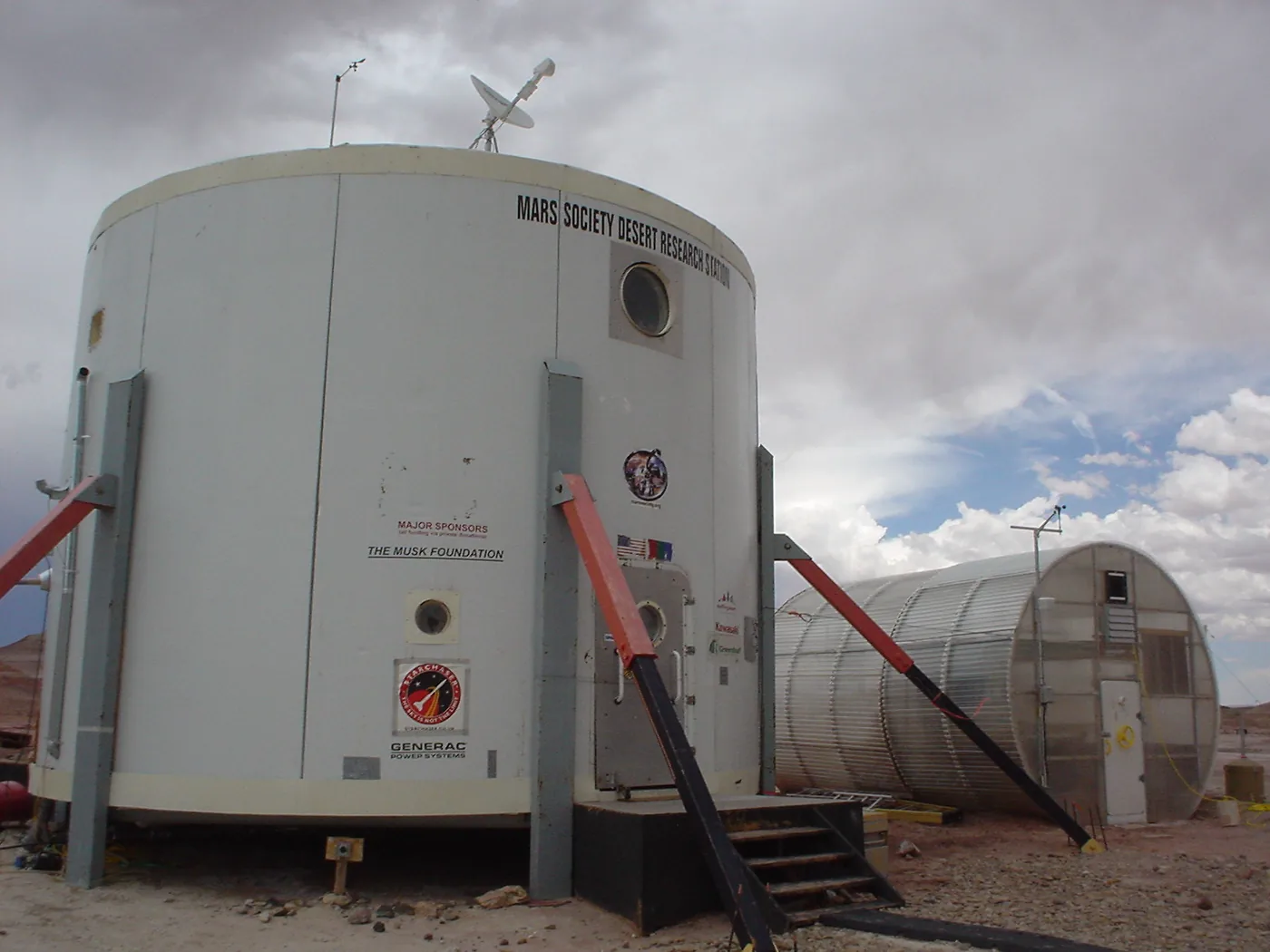
A rover that passes its bench test on campus can still fail at the Mars Desert Research Station, and the gap between the two is thermal, mineral and logistical. The 2027 rules state the environment in 27 words: 37.8 °C, dust, light rain, no heavy rain S-URC27-RULES §3.d.iii. This page sizes the thermal problem from a steady-state box model, treats the dust as the clay and salt mixture it actually is rather than as sand, and prices field repair against the clock the rules run. Where a number does not exist, the page says so.
Key takeaways
- The rulebook number is not the design number. A sealed black box at 38 °C ambient with 40 W inside reaches 77 °C internal, and the same box painted white reaches 55 °C, with a sunshade 50 °C and with a filtered fan 42 °C.
- Paint is the biggest single lever at 22 K, a shade adds 5 K and forced air another 8 K. A fan without a speed alarm is not a thermal design, and a top-only shade stops working when the sun drops.
- The dust is montmorillonite and sulfate salt at pH 8–9, finer than the dust an ingress rating is tested with, swelling when damp and conductive when wet. Connectors and crimps are the leading mission stopper, and they are the cheapest thing to fix.
- Repair between missions is free and repair during one costs 20 % with the clock running S-URC27-RULES §3.e.viii. The strategy is a fast module swap, a cloned boot medium and a field kit traceable to a failure list.
What the subsystem must do
The environmental requirement is short and leaves four things out. It does not say that the ground and an enclosure run far hotter than the air, that the finals window is not one temperature, that the site sits at 1,309 m where air density is about 85 % of sea level, or that testing at MDRS is forbidden before, during and after the competition S-URC27-RULES §3.d.iv. It also does not mention that there is no mobile coverage, that the nearest parts are about six hours away, and that the last 3.2 miles are a dirt road with a cattle grate and a short steep incline S-URC-ADVICE S-URC-LOGISTICS.
Three consequences follow for a first build. The rover must be its own test site, because the real one is unavailable. Every mission-critical function must be repairable from what the team carried in, because there is no ordering of parts. And the thermal design must be sized for a parked rover in the sun, because that is the worst case, not a moving rover on a cool morning.
The numbers that size the design
Ambient rows are sourced from the rules and from a reanalysis of the finals window. Internal temperatures are predictions from a steady-state box model, not measurements.
| Quantity | Value | Basis |
|---|---|---|
| Ambient, daily maximum, 2–5 June | 25.3–36.7 °C for 2020–2025; 32.6–35.9 °C in 2026 | Size the enclosure for 40 °C air, not 37.8 °C S-ERA5-MDRS-JUNE |
| Ambient, daily minimum, same window | 12.3–21.4 °C | Cool nights; a pack at 12 °C has higher internal resistance |
| Hanksville normals | June high 32.8 °C, July high 35.6 °C | The finals are about 3 °C cooler than the site’s worst month S-WEATHERSPARK-HANKSVILLE |
| Solar noon elevation, 21 June | 75.0° | At noon a flat shade works; by 18:00 the west face is the problem |
| Solar resource | 8.5 kWh/m²/day in June; peak about 1,000 W/m² | A black lid is a 200–400 W heater |
| Wind, 10 m maximum, 2–5 June | 14–36 km/h, gusts to 66.6 km/h; drones must be designed for 48 km/h | Dust load, sandblast, antenna and crate tie-down loads S-ERA5-MDRS-JUNE S-URC27-RULES §2.b.vi |
| Dust carried into the habitat | more than 50 g over 12 simulated EVAs | Terrain, not wind alone, loads dust onto hardware S-BOS-SCOTT-2004-DUST |
| Soil mineralogy | montmorillonite, nontronite and illite, sulfate-dominated, pH 8–9 | The clay in bentonite: swells when wet, clogs filters, conducts when damp S-STOKER-2011-MDRS-SOILS |
| Highest material limit that bites | PLA softens at 55 °C | Inside the box band and inside a closed vehicle S-PRUSAMENT-PLA |
| Sealed black box, 38 °C ambient, 40 W | 77 °C internal, 39 K above ambient | Steady state, still air, noon |
| Site surface temperature | not published | An infrared thermometer on the lid is the measurement that closes it |
Design space, in one table
| Decision | Options | Recommended for a first build |
|---|---|---|
| Enclosure | fully sealed and gasketed · filtered fan-pressurised · open with conformal coating · hybrid · heat exchanger | A sealed compute box with splash-shielded drive electronics, putting the sealing effort where the fragile and hot parts are |
| Thermal | white skin · sunshade · filtered forced air · heat spreader · a paraffin heat store · thermoelectric cooler | White box, a shade with at least 50 mm of overhang, one filtered fan with a speed alarm, and a heat spreader to the skin |
| Connectors | sealed automotive connectors · circular industrial connectors · hobby connectors · sealed bearings · conformal coating | Latched sealed connectors, strain relief within 50 mm, dielectric grease, and a coating that stops at the contact |
| Sensors that see dust | resistive potentiometers · magnetic encoders · sealed switches | Contactless magnetic encoders and Hall end-stops, because a contaminated potentiometer track fails intermittently |
| Fasteners | threadlocker · nylon-insert nuts · plain nuts with witness marks | Threadlocker on metal joints, nylon-insert nuts on plastic, and paint-pen marks on every critical fastener |
| Transport | strapped in a vehicle · a plywood crate with a bolted pallet and foam · a flight case | A crate with 25–50 mm closed-cell foam and a logged road test, never a van for the finals trip |
The thermal ladder
A 0.40 × 0.30 × 0.20 m box has 0.52 m² of skin. Still-air conductance is 6.0 W/K, and internal forced air at 1–2 m/s raises it to 16.4 W/K. At 38 °C ambient, 1,000 W/m² of beam, a solar elevation of 75° and 40 W of electronics, the same box four ways:
| Case | Solar absorbed | Rise above ambient | Internal |
|---|---|---|---|
| Black, sealed, no shade | 195 W | 39 K | 77 °C |
| White, sealed, no shade | 62 W | 17 K | 55 °C |
| White, shaded | 30 W | 12 K | 50 °C |
| White, shaded, filtered fan | 30 W | 4.4 K | 42 °C |
| Reference: black, shaded, fan | 96 W | 8.4 K | 46 °C |
Two readings matter. Paint is worth 22 K and it is free at the design stage, which makes a black lid the most expensive aesthetic decision on the rover. And a sealed, white, shaded box is still 12 K above ambient at 40 W, so “sealed and white” alone is not a thermal design; it is the starting point for one.
The shade geometry is usually wrong. A shade at height h displaces its shadow by h divided by the tangent of the solar elevation: at noon a 25 mm standoff moves the shadow only 6.7 mm, but at 29° elevation the offset is 45 mm and the west face becomes the absorber. A top-only shade is therefore a noon device. The shape that works is an open-bottomed cap with at least 50 mm of overhang on all four sides, about 0.35 kg in 0.5 mm aluminium for a box this size.
The fan needs two corrections that a bench test hides. At 1,309 m and 38 °C the air density is 0.96 kg/m³ against 1.13 at sea level, which is 85 %, so mass flow and heat transfer fall by 15 % for the same fan speed. And the filter adds back-pressure. Two independent sizings, 10.3 CFM by rule of thumb and 12.8 CFM from the physics, agree within 25 %, which gives 13 CFM at the site; adding 30–50 % for the filter points to a 40–60 mm fan rated at 20 CFM or more free delivery, with the filter mounted outside the box. Filter face area, not filter grade, sets service life: a fan’s own 25 × 25 mm intake has 6.25 cm², while a remote 80 × 80 mm filter has 64 cm² and ten times the dust capacity for the same flow.
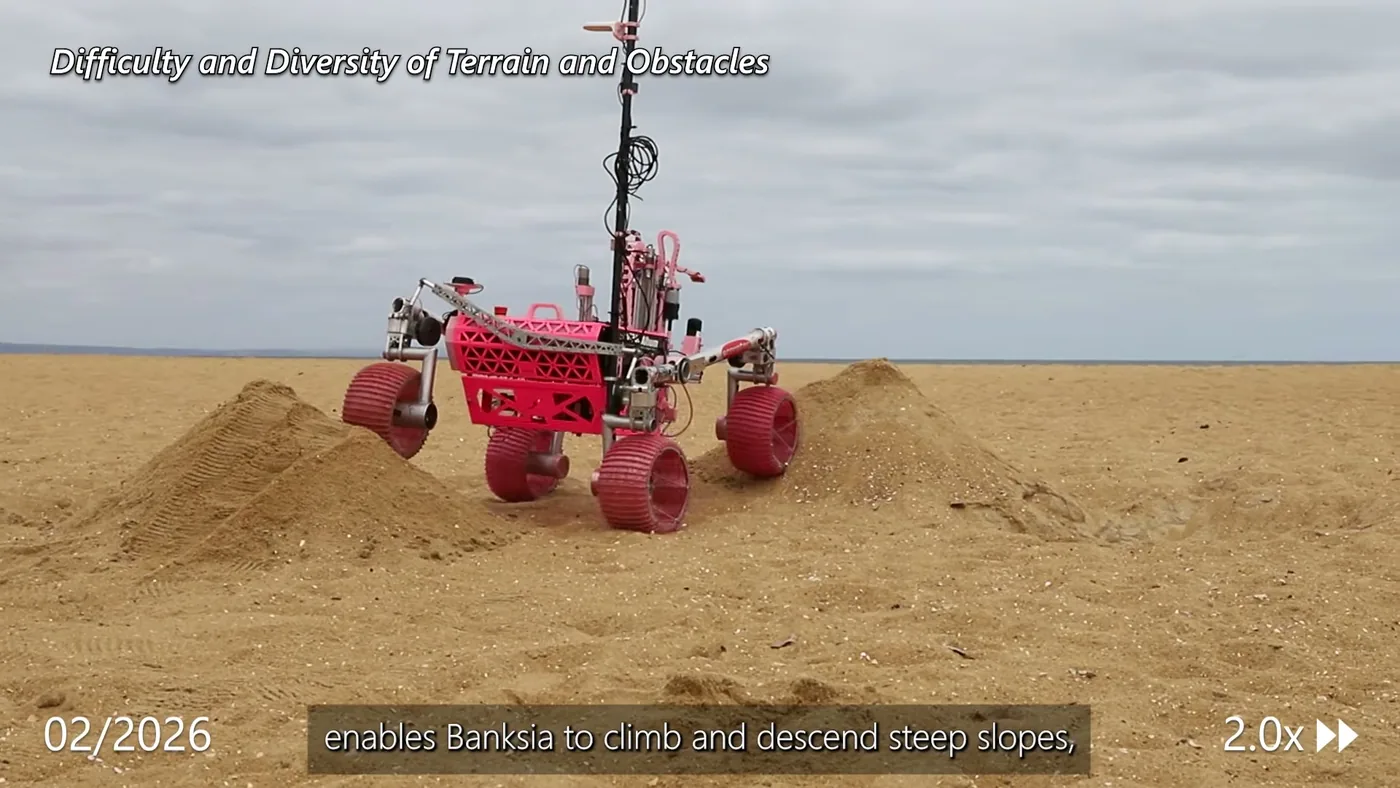
Two more thermal numbers are worth carrying. A stalled arm joint dissipates about 140 W in a winding with a thermal mass near 500 J/K, which is 0.28 K per second at first and an equilibrium 70 K above ambient, so a hold that is comfortable for a minute passes a derating threshold in four or five. And a compute module that throttles at minute twelve of a 40-minute run looks exactly like a software defect, which is why the temperature channel and a “too hot” state belong on the operator display.
The dust is clay and salt, which is worse than sand
The soils around the station are rich in montmorillonite, nontronite and illite, sulfate-dominated and basic at pH 8–9 S-STOKER-2011-MDRS-SOILS. Three properties follow, and none of them is captured by a rating printed on a component.
- It is finer than the dust an ingress rating uses. Clay minerals are defined below about 2 µm, while the standard ingress test uses a dry, free-flowing talc-based dust. Passing the test on talc is not a promise about a hygroscopic clay.
- It swells and cakes when damp. With morning dew or one shower, a dry powder becomes a paste that bridges connector contacts and packs into gear teeth.
- It is salty. Sulfate salts are soluble, so a damp film on a circuit board is an electrolyte. Dust at this site is a corrosion problem as well as an abrasion problem.
No team publishes per-component failure counts, so the ranked failure list is a mechanism-based prior rather than a census: 1 connectors and crimps, 2 fans, 3 lenses, 4 USB and HDMI ports, 5 potentiometers, 6 limit switches, 7 bearings and gearboxes, 8 heat-sink fins. The leading two are cheap to fix and expensive to ignore. Connectors want a latch, a pull-tested crimp, a service loop and dielectric grease; fans want a speed alarm and an oversized remote filter.
Cleaning is a scheduled activity, not a reaction. A twelve-minute routine of brush, filter, lens, connector check and a look for dust trails fits the ten-minute turnaround only when it is split across two missions, which makes it a between-mission task rather than a between-task one. And PLA has no place anywhere it can get hot: at a 55 °C softening point it sits inside the box band and inside a closed June vehicle, and the failure is silent creep that gets misdiagnosed as software.
A repair costs 20 % of a mission, so build for the swap
A runner may fix the rover in place, take it to the station or return it to the start S-URC27-RULES S-URC27-RULES §3.e.i §3.e.iv, but a team member who leaves the station cannot operate again that mission S-URC27-RULES §3.e.iii. Every intervention costs 20 % of the mission’s points and the penalties are additive, so two interventions leave 60 % of the points earned S-URC27-RULES §3.e.viii.
The design rules that follow are not heroic. Repair between missions is free, so the kit’s job is to make that repair fast. The swap must be possible without a laptop, a manual or a phone call, which means a keyed connector and a printed removal procedure for every mission-critical module. And some repairs are not worth doing: if the remaining points are worth less than 20 % of what is already banked, the mission is abandoned and the hardware is saved for the next one.
| Failure | Field repair | Target time | Spare needed |
|---|---|---|---|
| Connector unlatched or crimp failed | Re-seat, replace a pre-made harness | 5 min | Pre-crimped harness per branch |
| Blown fuse | Replace, then find the cause before re-powering | 2 min | Fuse assortment, two of each rating |
| Motor controller dead | Swap the controller and re-flash parameters | 15 min | One spare per class |
| Motor or gearbox failure | Swap the actuator assembly | 30–60 min | One spare actuator or a rebuild kit |
| Tyre puncture or delamination | Swap the wheel | 10–15 min | One spare wheel and nuts |
| Seized bearing | Press or pull the bearing and replace | 30–45 min | Bearing set and puller |
| Camera or USB failure | Swap the camera and re-plug the cable | 10 min | One spare camera and cable |
| Compute will not boot | Boot from a known-good image, or swap the board | 10–20 min | Cloned boot medium, spare board |
| Firmware regression | Roll back to the tagged known-good build | 15 min | Tag plus an offline copy of the code |
| Battery pack failure | Swap the pack and isolate the bad one | 10 min | A second pack |
Spares classify by one question: if this fails, can the rover still score? Class A is mission-stopping and cheap, so it travels at two to three times: fuses, connectors, crimps, wire, heat-shrink, tape, threadlocker, grease, cleaning fluid, boot media, fasteners. Class B is mission-stopping and expensive, so it travels once and is proven before departure: one spare controller per class, one actuator, one camera, one radio, one compute path, one battery. Class C is recovery only and can live in the vehicle: chassis plate, rivets, spare wheel, spare mast. Spares and equipment used to maintain the rover are excluded from the 50 kg limit S-URC27-RULES §2.a.iii, which is why the kit can be generous.
Transport is the strategy’s first test. A 100 kg crate in a 0.8 g stop needs 785 N of restraint; a 100 mm drop onto 25 mm foam is about 4 g, and onto 10 mm foam about 10 g. A 50 kg rover at 10 g puts 4.9 kN into four anchors, which an M5 bolt survives and a T-nut in 12 mm plywood does not. The qualification is one logged afternoon: an accelerometer at 100 Hz or better on the crate floor, 60 minutes of driving including 10 of washboard, the same checklist before and after, and every fastener marked with a paint pen.
Interfaces that bite
- Mobility and arm. Sealed hubs add drag and vented hubs ingest clay, so the decision is made before the wheel is machined. A long arm hold is a continuous thermal load that a brake would remove, at the worst place to add mass: the arm’s far end.
- Communications. A 3 m antenna limit, a 25 m cable run and a 66.6 km/h gust are in tension, because a larger antenna buys link margin and costs mast stiffness.
- Power. A 355 Wh 6S pack or a 592 Wh 8S pack both exceed the 160 Wh aircraft limit, so the pack is freight, a purchase in the United States, or a drive S-FAA-LITHIUM.
- Software and operations. Throttling at minute twelve looks like a software bug, so software owes a temperature channel and a visible “too hot” state. The crate is the weigh-in box, the shock absorber and the field bench at once.
- Systems engineering. The crate and the kit belong in the transport plan and the mass model, even though spares are excluded from the rover mass.
Failure modes
- The connector that let go in transit. The judges name loose wires and connectors as the most common way a rover works in the parking lot and fails at the site S-URC-ADVICE. Latched connectors, strain relief and witness marks are the prevention.
- The fan that blinded its own filter. Clay loads the blades, the bearing ingrates and the filter blinds, and the only symptom is a temperature that climbs. An oversized remote filter and a speed alarm convert a silent failure into an alarm.
- The potentiometer with a dead spot. A contaminated track jumps, calibration drifts, and a joint position becomes untrustworthy. Contactless magnetic encoders and Hall end-stops remove the mechanism entirely.
- The PLA bracket that crept. Softening at 55 °C produces sag and misalignment in a sun-loaded box. Anything hot is metal, ASA or PC.
- The fastener that seized. A sulfate film plus morning dew between stainless and aluminium seizes a fastener in a week. Anodising, nylon washers and dielectric grease are the answer.
- The firmware that would not boot. A hard kill can corrupt a filesystem and there is no network to recover from. A read-only root, cloned boot media and tagged builds make the recovery a swap.
- The missing two-dollar part. The nearest supplier is six hours away, so a missing connector ends an event after the diagnosis.
Shortlist for a first build
- Sealed white compute box, a shade with 50 mm of overhang, one filtered fan with a speed alarm, and a heat spreader to the skin, when the compute dissipates 15 W or more. A fanless sealed box works below about 10 W with 0.5 m² of skin.
- Latched sealed connectors, service loops, dielectric grease and a conformal coat that stops at the contact. This is the cheapest fix for the most common mission stopper.
- A plywood crate with at least 1.25 m internal, a bolted pallet, closed-cell foam, ratchet straps and a logged 60-minute road test. The crate is also the weigh-in box.
- A field kit built from the failure list, with the cheap mission-stopping class at two or three times, and module swaps rather than field soldering.
- A colour scheme and a finish chosen for thermal reasons: white or bright on every sun-facing surface, no black lids, no printed parts in the hot path.
Open problems
- What is the dust size distribution at rover height? The published MDRS work measures habitat intrusion, and the particle counts are behind a paywall. An optical particle counter at wheel height for 30 minutes produces the number.
- What is the real surface temperature of a sun-loaded lid? The model says 50–77 °C and no site measurement exists. An infrared thermometer on the lid, the battery box and the wheel hubs at 13:00 and 17:00, over five days, settles it.
- Does an ingress rating mean anything for clay? The standard test dust is talc. A team-defined clay-and-vibration test, published with its method, is the only honest answer.
- What is the filter service life in clay dust? Running the fan through a pre-weighed filter for an hour in the dustiest local conditions gives a flow drop and a service interval.
- What does the road do to the rover’s mounts, rather than to the crate? Logging an accelerometer on the chassis instead of the crate produces the load case the design actually sees.
- Can a first-season team hit a 20-minute repair? The times above are targets. A “dark rover” drill, in which a team-mate disables one item at random and the crew diagnoses it outdoors against the clock, turns them into data.
Further reading
- Missouri S&T and Monash both document sealed or fan-cooled electronics and the failures that followed.
- Power, electrical architecture and safety owns the pack, the fusing and the thermal limits this page assumes.
- Compute, sensors and perception owns the module that has to survive the box.
- How rovers fail places these mechanisms in the wider failure record.
- Site, travel and field constraints covers the road, the altitude and the rules of the site.
Sources for this page
- S-URC27-RULESUniversity Rover Challenge 2027 – Requirements and GuidelinesOriginal Archived copy
- S-URC-ADVICEURC Advice (judges' systems-engineering lessons)Original Archived copy
- S-URC-LOGISTICSURC LogisticsOriginal Archived copy
- S-ERA5-MDRS-JUNEERA5 reanalysis, daily temperature / shortwave / wind for 2–5 June, 2020–2026, at 38.406 N, 110.792 W, 1,377 m (Open-Meteo Historical Weather API)Original
- S-WEATHERSPARK-HANKSVILLEClimate and Average Weather Year Round at Hanksville, Utah (monthly normals, cloud, wind, solar)Original
- S-BOS-SCOTT-2004-DUSTMars Habitat Dust Contamination from Simulated Extra-Vehicular Surface Activity (MDRS 2003 crew) and Habitat Dust Contamination at a Mars Analog, GSA Special Paper 483:137–155 (abstracts read in a compilation)Print copy
- S-STOKER-2011-MDRS-SOILSMineralogical, Chemical, Organic and Microbial Properties of Subsurface Soil Cores from Mars Desert Research Station (Utah, USA), Int. J. Astrobiology 10(3):269–289 (abstract read in a compilation)Print copy
- S-PRUSAMENT-PLAPrusament PLA, material propertiesOriginal
- S-FAA-LITHIUMPack Safe, Lithium batteries (passenger rules)Original